
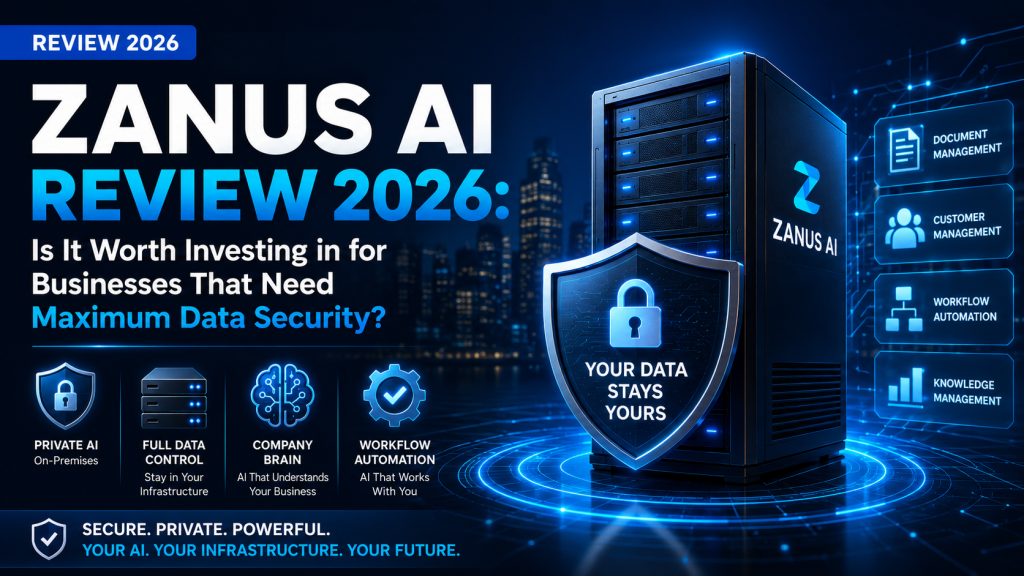
ChatGPT is powerful—but not every business can send its data to the cloud.
Artificial intelligence is transforming the way businesses operate. From drafting documents and analyzing data to supporting customer service, AI platforms like ChatGPT and Claude help organizations save time, improve productivity, and reduce operational costs.
However, for companies handling customer records, financial data, legal documents, or R&D materials, the biggest question is no longer how smart an AI model is.
Instead, it becomes:
- Where is our data processed?
- Who controls that data?
- How much will AI cost as adoption grows across the organization?
These concerns have driven growing interest in Private AI—an approach that deploys AI inside a company’s own infrastructure instead of relying entirely on cloud-based services.
Zanus AI is one of the platforms built around this philosophy.
Unlike ChatGPT or Claude, Zanus AI is not designed to be another conversational AI assistant. Instead, it aims to provide businesses with a complete AI infrastructure for knowledge management, workflow automation, and enterprise-wide AI deployment—all running within the organization’s own environment.
In this review, ThomasReview evaluates Zanus AI from the perspective of businesses considering a long-term AI investment. We’ll explore what makes it different, how it compares with ChatGPT Enterprise and Claude Enterprise, and which organizations are most likely to benefit from its approach.
Quick Verdict
| Criteria | Rating |
|---|---|
| Product Direction | ⭐⭐⭐⭐⭐ Enterprise Private AI |
| Data Security | ⭐⭐⭐⭐⭐ |
| Scalability | ⭐⭐⭐⭐ |
| Initial Investment | High |
| Best For | Organizations deploying AI on their own infrastructure |
The Bottom Line
Pros
- AI runs inside the organization’s infrastructure.
- No token-based pricing according to Zanus AI’s deployment model.
- Designed for long-term enterprise AI adoption.
- Strong focus on knowledge management and workflow automation.
Cons
- Higher upfront investment than cloud-based AI services.
- Best suited for medium and large organizations rather than individual users.
What Is Zanus AI?
Zanus AI is an on-premises Private AI platform that combines an AI Server with an AI Operating System into a single enterprise solution.
Instead of sending business data to external AI providers, the platform processes information within the company’s own infrastructure, giving organizations greater control over where their data resides and how it is managed.
More importantly, Zanus AI is not positioned as a chatbot.
Its vision extends beyond answering prompts. The platform is designed to become an AI layer that supports day-to-day business operations through knowledge management, automation, and enterprise applications.
In simple terms:
- ChatGPT focuses on being an AI Assistant.
- Zanus AI focuses on becoming an AI Operating System.
That distinction defines almost every aspect of the platform.
ThomasReview’s Take: Comparing Zanus AI directly with ChatGPT misses the point. One is primarily an AI assistant, while the other is an enterprise AI infrastructure designed to operate inside an organization’s own environment.
What Makes Zanus AI Different?
After reviewing the available documentation, the biggest difference isn’t the language model itself.
It’s how AI is deployed.
While most enterprise AI platforms operate through cloud services, Zanus AI allows organizations to own and manage their AI infrastructure.
That means:
- Business data stays inside the organization’s environment.
- Access permissions remain under the company’s control.
- Organizations are not fully dependent on third-party cloud infrastructure.
- According to Zanus AI, the platform does not charge based on tokens or the number of AI queries after deployment.
The trade-off is equally clear.
Instead of paying a monthly subscription for cloud AI, businesses invest in dedicated AI infrastructure upfront.
🖥️ Planning to build your own AI infrastructure? Choosing the right operating system matters too. Before you decide, check out our guide: Thinking About Switching From Windows to Ubuntu? Read This First.
In other words, Zanus AI exchanges higher initial investment for greater data control and more predictable long-term operating costs.
ThomasReview’s Take: This is the platform’s defining advantage. Organizations looking for a simple AI chatbot may see little benefit. Companies that prioritize security, compliance, and long-term AI adoption are far more likely to appreciate this approach.
Key Features
Rather than listing every module available in the platform, these are the four capabilities that best define Zanus AI.
1. Private AI Running Inside Your Organization
Everything starts here.
Instead of relying on cloud infrastructure, Zanus AI runs directly on the organization’s AI Server.
Because data processing happens internally, businesses retain greater control over sensitive information and can align AI deployment with their own security policies.
For industries such as finance, healthcare, manufacturing, and government, this deployment model is arguably the platform’s biggest advantage.
2. Company Brain: AI That Understands Your Business
An AI assistant is only as useful as the information it can access.
Instead of relying primarily on general model knowledge, Zanus AI introduces the concept of Company Brain—a centralized enterprise knowledge base built from the organization’s own documents.
The platform can index materials such as:
- Standard Operating Procedures (SOPs)
- Contracts
- Internal documentation
- Training materials
- Business forms
- Operational knowledge
AI can then retrieve and use this information when answering questions or assisting employees.
The result isn’t simply an AI that knows more.
It’s an AI that understands your business.
ThomasReview’s Take: Company Brain is arguably Zanus AI’s most valuable capability. Organizations with large volumes of internal documentation may gain significantly more value from this feature than from a traditional AI chatbot.
3. AI That Supports Business Operations
Most AI assistants focus on conversations.
Zanus AI goes beyond that.
The platform integrates enterprise modules such as document management, customer management, workflow automation, scheduling, and website chatbots into a unified system.
Rather than acting as a standalone chatbot, AI becomes part of everyday business processes.
That’s an important distinction.
It’s the difference between using AI occasionally and building AI into the way an organization operates.
4. No Token-Based Pricing
According to Zanus AI’s published deployment model, organizations are not charged based on tokens or AI queries after the system has been deployed.
For businesses with hundreds of employees using AI daily, this approach offers a more predictable long-term cost structure compared to usage-based pricing models.
The trade-off, however, is a higher upfront investment in infrastructure.
For organizations planning to scale AI across multiple departments, that trade-off may be worthwhile.
Is Zanus AI Worth the Investment?
After reviewing Zanus AI’s official documentation, one thing became clear: this platform is not designed for every business.
Its value becomes apparent only when AI is viewed as a long-term technology investment rather than a productivity tool for individual employees.
If your organization simply needs AI for writing emails, summarizing documents, or answering everyday questions, cloud-based platforms like ChatGPT Enterprise or Claude Enterprise are easier to deploy and require a much lower upfront investment.
However, if your goal is to build an enterprise AI infrastructure that protects sensitive data while supporting business operations at scale, Zanus AI offers a very different approach.
Why Businesses Should Consider Zanus AI
1. Full Control Over Business Data
The strongest reason to consider Zanus AI is data ownership.
Unlike cloud-based AI services, Zanus AI is deployed within the organization’s own infrastructure. Business data remains inside the company’s environment instead of being processed by an external AI provider.
For industries where data confidentiality is critical—such as finance, healthcare, manufacturing, legal services, and government—this deployment model can significantly reduce concerns about data governance and compliance.
ThomasReview’s Take: If protecting business data is your highest priority, this is Zanus AI’s biggest competitive advantage.
2. More Predictable Long-Term AI Costs
Most enterprise AI platforms charge recurring subscription fees or usage-based costs.
As AI adoption expands across an organization, monthly expenses often grow alongside the number of users and AI requests.
Zanus AI follows a different model.
According to the company’s published information, organizations are not charged based on tokens or query volume once the platform has been deployed.
That doesn’t mean the solution is inexpensive.
Instead, the investment shifts from ongoing usage costs to upfront infrastructure costs, making long-term budgeting more predictable for organizations planning enterprise-wide AI adoption.
3. AI Becomes Part of Business Operations
One aspect that stands out is Zanus AI’s broader vision.
Rather than positioning AI as a standalone assistant, the platform integrates AI into document management, enterprise knowledge, workflow automation, customer management, and other operational processes.
In practice, this means employees interact with AI as part of their daily workflow instead of treating it as a separate application.
For organizations pursuing digital transformation, this is a more strategic use of AI than simply deploying another chatbot.
What You Should Consider Before Investing
The same characteristic that makes Zanus AI attractive can also become its biggest barrier.
Unlike ChatGPT Enterprise or Claude Enterprise, Zanus AI requires organizations to invest in dedicated AI infrastructure before deployment.
The company does not publish fixed pricing, instead providing quotations based on each organization’s requirements.
For businesses with only a handful of AI users, that upfront investment may be difficult to justify.
On the other hand, organizations planning to deploy AI across multiple departments may find that infrastructure ownership offsets long-term operational costs.
ThomasReview’s Take: This isn’t a weakness—it is a strategic trade-off. Zanus AI exchanges low entry costs for greater long-term control.
Zanus AI vs. ChatGPT Enterprise vs. Claude Enterprise
Choosing between these platforms isn’t about selecting the “best AI.”
It’s about choosing the deployment model that fits your organization.
| Criteria | Zanus AI | ChatGPT Enterprise | Claude Enterprise |
|---|---|---|---|
| Deployment | On-Premises | Cloud | Cloud |
| Infrastructure Ownership | Organization-owned | Managed by OpenAI | Managed by Anthropic |
| Data Processing | Within the organization’s infrastructure | Subject to OpenAI Enterprise privacy policies | Subject to Anthropic Enterprise privacy policies |
| Pricing Model | Infrastructure investment, no token-based pricing according to Zanus AI | Subscription | Subscription |
| Deployment Speed | Longer implementation | Fast | Fast |
| Best For | Private AI deployment | Organizations adopting AI assistants | Organizations already using Claude in enterprise environments |
Which One Should You Choose?
Choose ChatGPT Enterprise if you want to deploy AI quickly without investing in infrastructure.
Choose Claude Enterprise if your organization prefers Anthropic’s ecosystem and primarily works in cloud environments.
Choose Zanus AI if your priority is building a secure, enterprise-owned AI infrastructure with full control over business data.
These products are not direct competitors—they represent three different approaches to enterprise AI.
Who Should Use Zanus AI?
Zanus AI is best suited for organizations that see AI as long-term infrastructure rather than a productivity tool.
| Recommended For | Why |
|---|---|
| Manufacturing companies | Internal technical documentation, SOPs, engineering knowledge |
| Banks and financial institutions | Sensitive customer and financial data |
| Hospitals and healthcare providers | Privacy-sensitive medical information |
| Law firms | Contracts and legal documentation |
| Government agencies | AI deployment within internal infrastructure |
| Enterprises undergoing digital transformation | Building a long-term enterprise AI platform |
Who Should Skip Zanus AI?
Not every organization needs Private AI.
If your requirements are relatively simple, cloud-based AI platforms may deliver better value.
| Not Recommended For | Why |
|---|---|
| Freelancers | No need for dedicated AI infrastructure |
| Bloggers and content creators | ChatGPT or Claude are more practical |
| Students | High infrastructure costs are unnecessary |
| Very small startups | Difficult to justify the initial investment |
| Users looking only for an AI chatbot | Cloud AI services are simpler and more cost-effective |
ThomasReview Verdict
After evaluating Zanus AI’s official materials, ThomasReview believes the platform should not be viewed as “another ChatGPT competitor.”
Its objective is fundamentally different.
Instead of delivering AI as a cloud service, Zanus AI enables organizations to build their own AI infrastructure, where business data, enterprise knowledge, and operational workflows remain under the company’s control.
That is both its greatest strength and its biggest commitment.
If your organization simply wants an AI assistant to improve day-to-day productivity, ChatGPT Enterprise or Claude Enterprise will likely be the better choice.
But if AI is becoming part of your long-term technology strategy—and protecting business data is a top priority—Zanus AI deserves serious consideration.
