
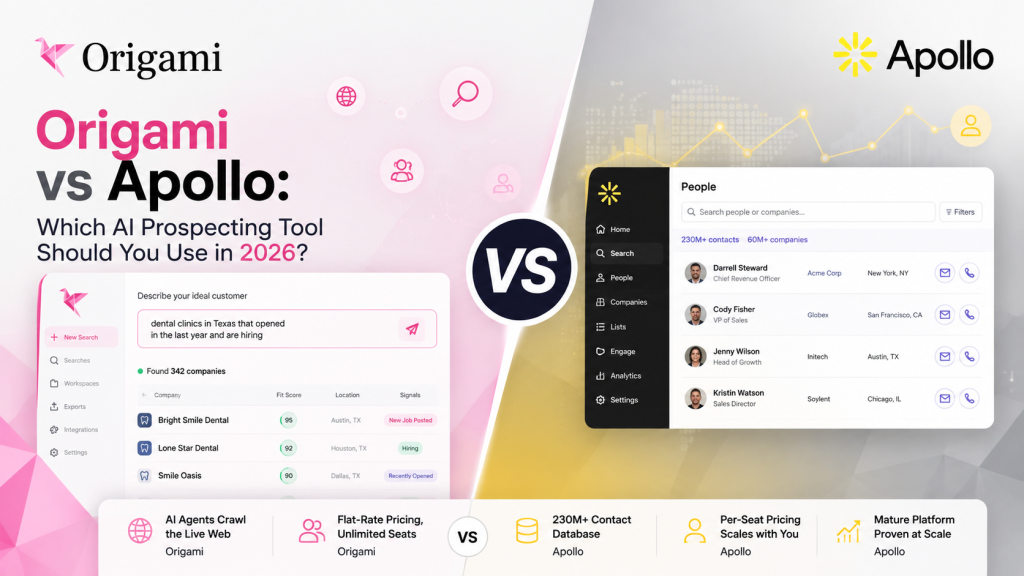
Quick Answer: Origami and Apollo solve B2B prospecting from opposite directions. Apollo is a mature, database-led platform with 230M+ contacts, per-seat pricing ($49–$119/user/month on annual billing, or $69–$149/user/month billed monthly), and a 4.7/5 rating across 9,000+ G2 reviews — strong for fast, consistent lookups on companies with an online presence. Origami is a newer (2024), AI-native platform that crawls the live web on each query instead of a static database, with flat-rate pricing ($29–$499/month, unlimited seats) — strongest for local businesses and niche/offline verticals that Apollo’s indexed data tends to miss. If your prospecting targets are mostly online, tech-forward companies, Apollo’s database depth is hard to beat. If you’re targeting local or offline businesses, Origami’s live-crawling approach is likely to surface more relevant leads.
1. What’s the Core Difference Between Origami Ai and Apollo Ai?
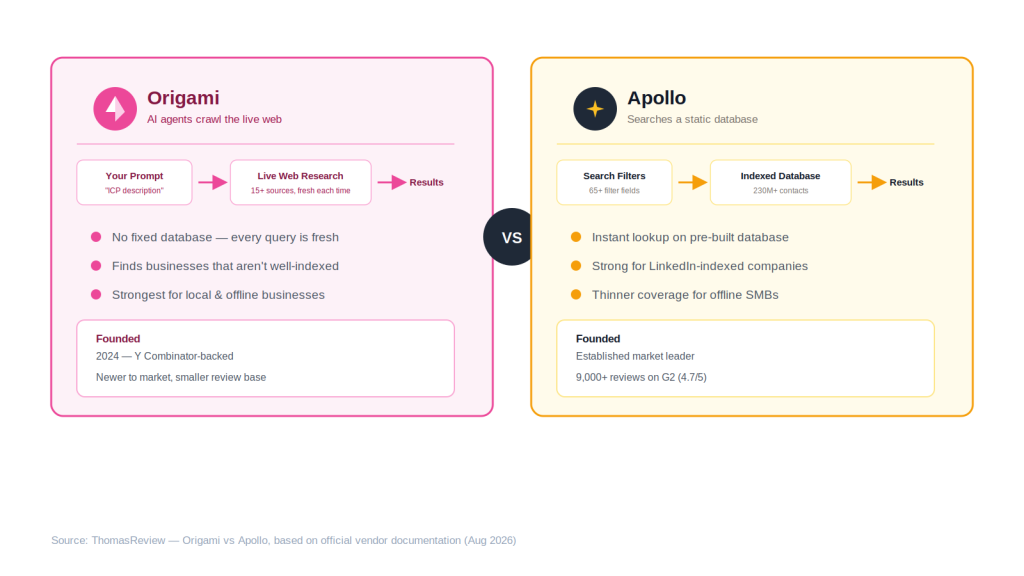
Quick Answer: Apollo searches a massive, pre-built database (230M+ contacts, 60M+ companies) using 65+ filters, while Origami’s AI agents research the live web on every query based on a plain-English prompt describing your ideal customer profile (ICP). Apollo is built for speed and scale on already-indexed data; Origami is built to find businesses that database vendors haven’t indexed well.
Apollo, founded years earlier and now backed by $150M+ ARR and 40,000+ paying customers, is a full-stack outbound platform — database, sequencer, dialer, CRM sync, and AI writing tools in one interface. Origami, founded in 2024 and backed by Y Combinator, is narrower in scope by design: a prompting-based research and enrichment layer that also includes a built-in sequencer, but doesn’t try to replace a full sales engagement suite the way Apollo does. For the full breakdown of Origami specifically, see our Origami AI Review.
2. Origami vs Apollo: Side-by-Side Comparison
| Criteria | Origami | Apollo |
|---|---|---|
| Founded | 2024 (San Francisco) | Earlier, now an established market leader |
| Core approach | AI agents crawl the live web per query | Searches a static, pre-built database |
| Database/coverage size | Not a fixed database — live research per query | 230M+ contacts, 60M+ companies (varies by source, up to 275M cited) |
| Pricing model | Flat rate: $0–$499/month, unlimited team members | Per-seat: Free, then $49–$119/user/mo (annual) or $69–$149/user/mo (monthly) |
| Contact reveal cost | Included in monthly credits, 0% markup on verification | Credit-based: 1 credit/email, 8 credits/phone reveal |
| Independent reviews | 3.7–4.7/5 depending on source, low review volume | G2: 4.7/5 (9,000+ reviews); Capterra: 4.5/5 (381 reviews) |
| Best-covered verticals | Local/offline businesses (HVAC, dental, restaurants) | Mid-size to large tech companies, strong US coverage |
| Known data weaknesses | Result variability between runs (fresh research each time) | Reported bounce rates of 15–25%; phone data weaker than email |
| Built-in sequencer | Yes, unlimited sends on paid plans | Yes, with A/B testing and conditional branching on higher tiers |
Table compiled from Origami’s and Apollo’s official pricing pages (verified directly, including both annual and monthly billing views), G2, Capterra, and third-party reviews as of August 2026. Contact database size figures for Apollo vary by source (210M–275M+); treat as directional rather than exact.
3. How Do Origami and Apollo’s Pricing Models Differ?
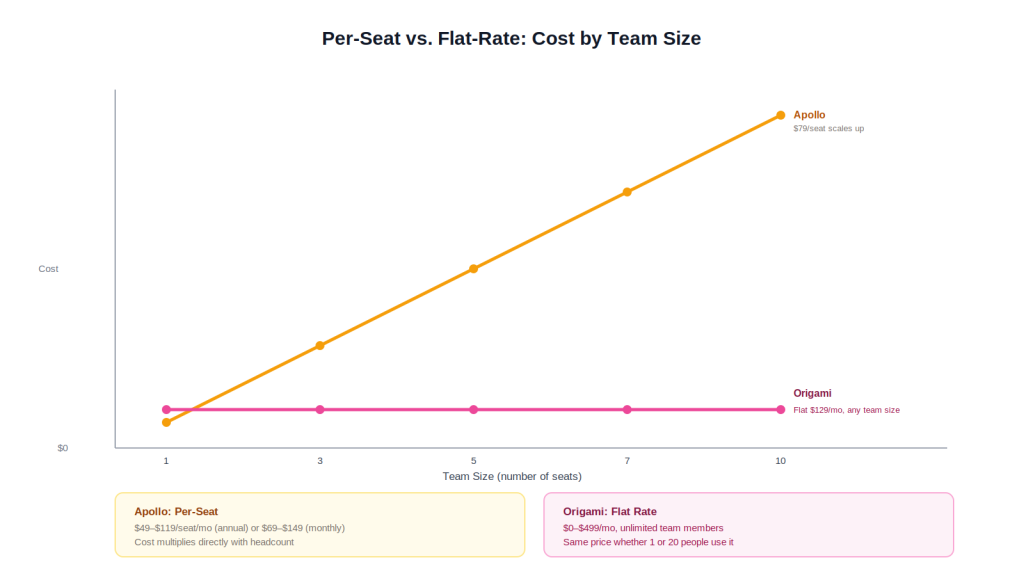
Quick Answer: The biggest structural difference is per-seat versus flat-rate: Apollo charges per user per month — $49/$79/$119 for Basic/Professional/Organization on annual billing, or $69/$99/$149 on monthly billing — so costs multiply directly with team size, while Origami charges a flat monthly fee with unlimited team members regardless of headcount.
For a 5-person team, Apollo’s Professional plan ($79/user/month annual) works out to roughly $395/month before any credit overages — while Origami’s comparable Pro plan is a flat $129/month no matter how many people are using it. That math flips in Apollo’s favor for a solo user or very small team, since Origami’s entry Starter plan ($29/month) still costs more than a single Apollo Basic seat in some billing scenarios. Both platforms also gate features behind higher tiers and consume usage-based credits (Apollo per reveal, Origami per research query), so sizing the right plan means estimating actual usage volume, not just headcount.
Apollo’s credit allocation also scales by tier: Free includes 900 credits/year per seat (75/month), Basic 30,000/year, Professional 48,000/year, and Organization 72,000/year — each credit typically covers one email reveal, with phone reveals costing 8 credits each.
4. Which Has Better Data Coverage?
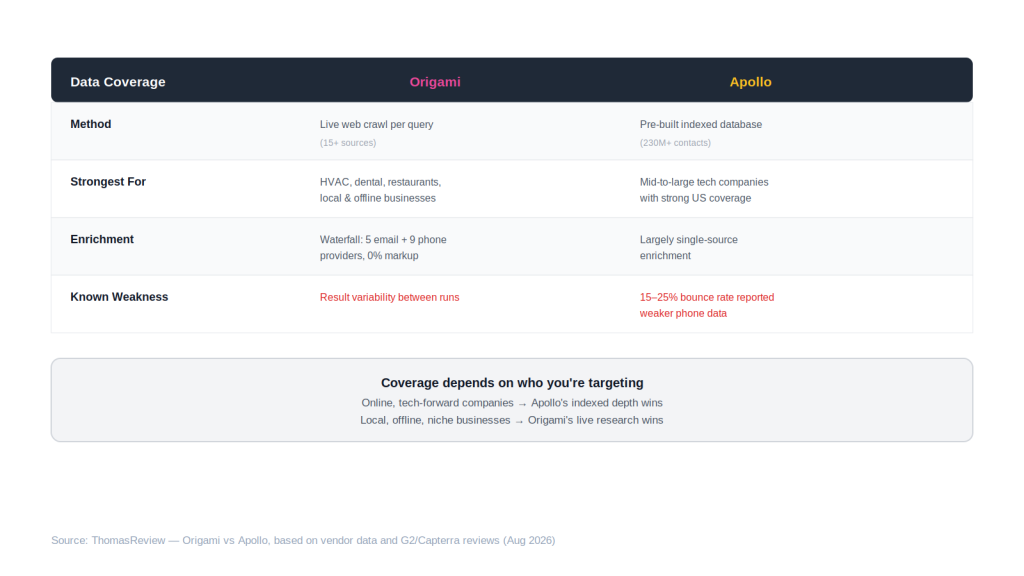
Quick Answer: It depends entirely on who you’re targeting. Apollo’s database is larger and faster for companies with an established online presence, particularly mid-size to large US tech companies, but independent reviews report real accuracy gaps — bounce rates of 15–25% and weaker phone data. Origami’s live-crawling approach is reported to surface more leads for local and offline businesses that Apollo’s indexed database covers thinly, at the cost of some result-to-result consistency.
One relevant technical detail: Apollo’s own enrichment is largely single-source, while Origami runs a waterfall search (querying multiple providers in sequence) across 5 email providers and 9 phone providers per contact — a structurally different approach to verification that both companies frame as reducing bad data, though from very different mechanisms (indexed accuracy vs. multi-provider cross-checking).
5. Which Platform Has More Proven Reliability?
Quick Answer: Apollo has a dramatically larger independent review base — 9,000+ ratings on G2 alone at 4.7/5 — compared to Origami’s much smaller and more scattered review footprint (3.7–4.7/5 across a handful of platforms). That gap reflects Apollo’s much longer time in market rather than a clear quality difference, but it does mean there’s simply more third-party evidence available for Apollo.
ThomasReview’s Take
The honest way to frame this comparison isn’t “which tool is better” — it’s “which tool was built for your target list.” Apollo’s scale advantage is real and well-documented: a massive, continuously updated database, a mature sales engagement suite, and nearly a decade of accumulated reviews. If your ICP is online, tech-forward, and has a LinkedIn footprint, that scale is hard to argue with, even accounting for the bounce-rate and phone-accuracy complaints that show up consistently in G2 reviews.
But Apollo’s architecture has a structural blind spot: it can only find what’s been indexed, and offline/local businesses — the HVAC company that doesn’t maintain an active LinkedIn page, the regional dental practice, the independent restaurant group — are exactly the kind of accounts that fall through that gap. Origami’s live-crawling approach is a genuinely different bet on solving that specific problem, and the flat-rate, unlimited-seat pricing is a real structural advantage for any team larger than one or two people. The tradeoff is that Origami is a much younger company with a fraction of the independent review volume, so you’re trading Apollo’s proven-at-scale track record for coverage in a market segment Apollo doesn’t serve as well.
6. Which Should You Choose?
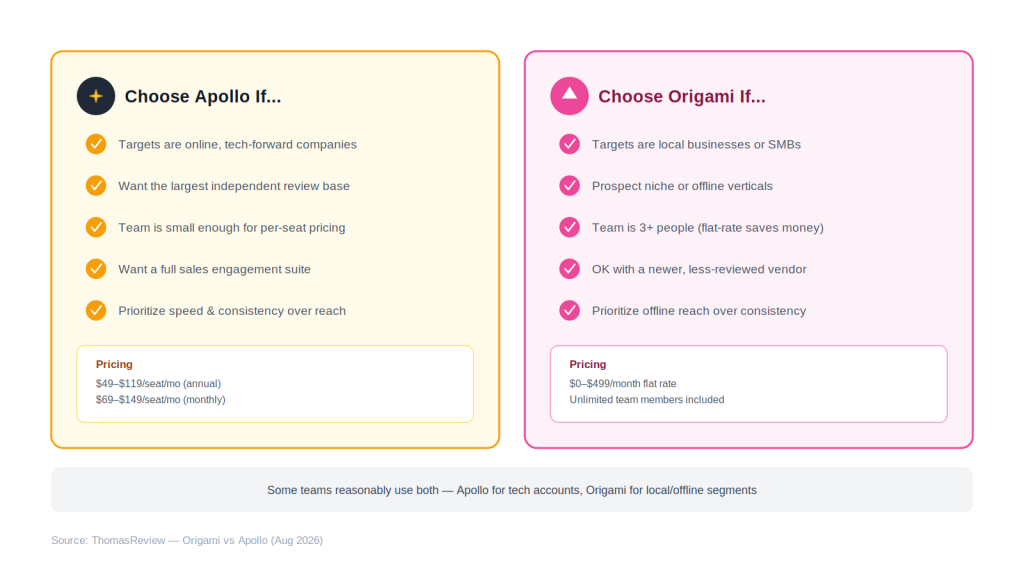
Quick Answer: Choose Apollo if your prospecting targets are primarily online, tech-forward companies, you want the most mature review base to reference, and your team is small enough that per-seat pricing stays manageable. Choose Origami if you’re targeting local businesses, SMBs, or niche offline verticals, you have a team where flat-rate pricing beats per-seat costs, and you’re comfortable with a newer, less-reviewed vendor.
Some teams may reasonably use both — Apollo for tech-sector accounts, Origami for local/offline segments — since the two tools are solving different halves of the same prospecting problem rather than directly competing for the same target list.
📌 Related Reading: For the full technical and pricing breakdown of Origami’s platform, see our Origami AI Review. Evaluating other AI tools for your GTM stack? See our Loop AI Review and Zanus AI Review.
Frequently Asked Questions
Is Origami cheaper than Apollo? It depends on team size. For teams of 3 or more, Origami’s flat-rate pricing is typically cheaper than Apollo’s per-seat model. For a single user, Apollo’s entry-level paid plan can work out cheaper than Origami’s equivalent tier — model your actual usage before deciding.
Does Apollo have a free plan like Origami? Yes. Apollo’s free plan includes unlimited email discovery with fair-use caps, roughly 900 general credits/year (about 75/month, used mainly for email reveals), a separate allocation of about 5 mobile/phone credits per month, and 10 export credits/month. Origami’s free plan includes 1,000 one-time credits and 20 messages to the agent, but no CSV export or contact reveal.
Which platform has better phone data? Neither is reported as strong on phone data specifically. Apollo’s phone credits cost 8x an email credit and reviewers report inconsistent accuracy; Origami’s phone data runs through a 9-provider waterfall search, but independent, large-sample reviews on phone accuracy specifically are limited for Origami so far.
Can I switch from Apollo to Origami, or use both? Yes to both. There’s no technical lock-in preventing either, and because the two tools have different coverage strengths (Apollo for indexed/online companies, Origami for local/offline businesses), some sales teams use both for different segments of their prospecting list.
ThomasReview Verdict
Apollo and Origami aren’t really fighting for the same prospecting job. Apollo remains the safer default for teams targeting companies with an established digital footprint, simply by virtue of scale and time in market. Origami is the more interesting bet for teams whose ideal customers are local or offline businesses that database-led tools consistently under-cover — and its flat-rate pricing is a genuine edge for any team beyond a couple of seats. Match the tool to your actual target list rather than picking based on brand recognition alone.
Sources
- Apollo.io official pricing page — verified plan pricing
- Origami pricing page — verified plan pricing
- Apollo.io Reviews — G2 — independent review data (4.7/5, 9,000+ reviews)
- Apollo.io Review 2026 — SalesHive — company background, ARR, customer count
- Apollo.io Pricing Breakdown 2026 — Salesmotion — pricing tiers and credit system
- Apollo.io Review 2026 — SyncGTM — data accuracy and enrichment comparison
- Origami AI Review — ThomasReview — full Origami platform breakdown
Disclaimer: Pricing, database size, and performance figures in this article are drawn from each vendor’s official materials and third-party reviews as of August 2026, and are subject to change. Apollo’s contact database size is reported differently across sources (210M–275M+); businesses should verify current figures and pricing directly with each vendor before making a purchasing decision.
