
Quick Summary
- Zanus AI doesn’t publish fixed pricing. Every quote is based on team size, concurrent users, and how much documentation needs to be processed.
- Zanus AI sells on a one-time CapEx model (buy the hardware and software outright) instead of a subscription — the three publicly listed tiers are Prime, Quantum, and Enterprise Cluster, all quote-based.
- A few independent review sites have estimated pricing for the Prime tier (roughly $20,000–$55,000 depending on configuration), but these are third-party estimates, not confirmed by Zanus AI.
- The real cost of Private AI goes well beyond the server price tag — it also includes deployment, maintenance, power and cooling, and, most importantly, IT staffing.
- Compared with ChatGPT Enterprise (market-reported pricing of roughly $45–$75 per user/month, with a ~150-seat minimum), where the break-even point lands depends heavily on team size and usage frequency.
1. How Does Zanus AI’s Pricing Model Work?
On its official product pages (zanusai.com), Zanus AI lists three hardware tiers, each aimed at a different scale of use:
| Product Line | Positioning |
|---|---|
| Zanus AI Prime | Entry-level AI server for smaller teams and moderate document libraries |
| Zanus AI Quantum | Balanced on-prem system for multiple concurrent users, RAG, and workflows |
| Zanus AI Enterprise Cluster | High-throughput private AI infrastructure supporting multi-node/InfiniBand/multi-tenant setups |
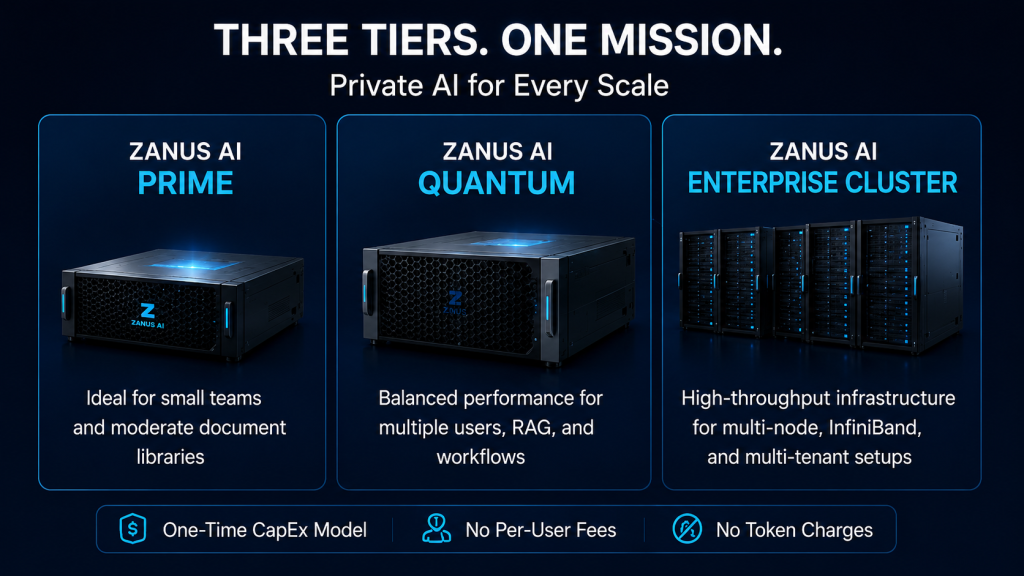
All three tiers say “Request Quote” — there’s no buy-now button with a listed price. According to the product pages, Zanus AI sizes each system based on:
- Number of users and required concurrency
- The volume of documents that need indexing for RAG
- Security requirements (whether air-gapping is needed)
- Workload type: internal chat, RAG, automation, API integrations
Every server ships with one industry-specific software package included at no extra charge — software isn’t billed separately, it’s bundled into the hardware quote. That’s a departure from the more common “buy the server, then buy a separate software license” model used by other on-premises AI vendors.
The key point on pricing structure: Zanus AI states it doesn’t charge based on tokens or query volume after deployment. What you pay up front — plus an optional annual maintenance fee — is the entire cost of using the software, with nothing added as usage scales.
2. Why Doesn’t Zanus AI Publish Its Prices?
There are a few technical and business reasons behind this — and it’s not unique to Zanus AI. Most enterprise-grade on-premises AI vendors do the same, including ChatGPT Enterprise and Claude Enterprise.
- Hardware configuration varies with actual need. Unlike SaaS, where one price fits every customer, an on-prem system has to be sized around GPU count, VRAM capacity, and node count — and those requirements look completely different for a 10-person law firm versus a 500-person financial institution.
- The bundled software package differs by industry. Since each server includes an industry-specific package (healthcare, legal, finance, and so on), customization costs vary too.
- Pricing leverage in B2B negotiations. Like most large enterprise infrastructure deals, vendors tend to keep pricing private to preserve negotiating room per customer, rather than publishing a list price and then having to discount across the board.
- Specialized security requirements — air-gapping for defense, government, or finance — add meaningful cost on top of a standard configuration, making it hard to fold into one blanket price.
In short, the lack of published pricing isn’t a red flag specific to Zanus AI — it’s simply how the enterprise Private AI infrastructure market works, where “one price for everyone” rarely holds up.
3. AI Server Cost
Since Zanus AI doesn’t publish official pricing, this section pulls together estimates from independent third-party sources to give you a reference point — not an official Zanus AI price list.
According to a few independent TCO analyses published in 2026:
- The Prime tier (entry-level, turnkey) is estimated by some sources to fall in the $19,900–$54,900 range for the initial purchase, depending on GPU configuration and the bundled software package.
- The Enterprise Cluster tier (multi-node) is estimated to reach $120,000–$150,000 or more for larger deployments.
- GPUs alone typically account for roughly 60–75% of total server hardware cost, according to broader industry analysis of on-prem AI infrastructure — not specific to Zanus AI.
These are third-party estimates, not confirmed publicly by Zanus AI. Actual pricing varies by configuration, quote timing, and deployment region. Contact Zanus AI directly for an accurate quote.
4. Deployment Cost
Beyond the hardware and software price, deployment cost is the line item businesses most often underestimate when first considering Private AI.
Zanus AI advertises fast deployment — systems operational within 3 weeks of order — positioned as a clear advantage over agentic AI integration projects that can take months to over a year. If accurate, that shortens the indirect costs (staff time, operational disruption) considerably compared with building an internal AI system from scratch.
Deployment costs worth accounting for regardless of whether you go turnkey or DIY:
- Physical setup and network integration: connecting the server to existing network infrastructure, configuring network security, and setting up air-gapping if required.
- Initial data ingestion: loading documents, processes, and contracts into the vector database so RAG actually works — the larger the data volume, the more time and effort this takes.
- Integration with existing systems: connecting the AI to a CRM, ERP, or existing document-management software is an add-on cost beyond the base server price.
- Staff training: even with a simple interface, the team still needs time to adapt to new workflows.
DIY builds (assembling your own hardware plus open-source software) typically carry significantly higher deployment costs, since the business has to handle driver configuration, RAG pipelines, permissions, and monitoring itself — work a turnkey solution already packages in.
5. Maintenance Cost
Maintenance is a recurring annual expense, distinct from the one-time upfront investment.
According to a few independent ROI analyses of Zanus AI:
- Hardware maintenance is typically free in year one (covered under warranty), then shifts to an annual SLA fee — some estimates put this at around $2,000/year for an entry-level Prime configuration, rising with system scale.
- On top of hardware maintenance, factor in power and cooling costs for a server running 24/7. Based on general industry TCO models, a mid-sized GPU cluster can run anywhere from a few thousand to tens of thousands of dollars a year in electricity, depending on scale and regional power rates.
- As a general benchmark for enterprise AI projects, annual maintenance (monitoring, updates, infrastructure management) tends to run 15–25% of the initial investment — an industry reference figure, not a Zanus AI–specific number.
These figures come from independent estimates or industry benchmarks, not an official Zanus AI price list. Confirm directly with the vendor before budgeting.
6. IT Staffing Cost
This is the line item most often left out of Private AI cost calculations — and according to many industry TCO analyses, it’s actually the largest long-term expense, outweighing hardware itself.
A few reference points from the on-premises AI infrastructure industry generally, not specific to Zanus AI:
- For a mid-size on-prem system, many analyses estimate roughly 0.5 FTE for an infrastructure engineering role, at a fully loaded cost of about $75,000–$100,000/year for one FTE — around $37,500–$50,000/year for a part-time allocation.
- For larger GPU clusters requiring clustering/InfiniBand expertise, a full-time AI infrastructure engineer can cost $150,000–$275,000/year, depending on the role and labor market.
- Systems requiring 24/7 monitoring often call for a minimum of 2–3 staff rotating shifts, which pushes total staffing costs up considerably.
Worth noting: since Zanus AI is marketed as a turnkey solution — pre-packaged hardware and software, deployed in 3 weeks — day-to-day operational burden may be considerably lighter than building a DIY GPU cluster from scratch. That said, the business still needs at least one internal IT point of contact to monitor the system, handle incidents, and manage access permissions.
7. TCO Over 3–5 Years
Total Cost of Ownership (TCO) is the most complete way to compare Private AI against other options, since it captures both the one-time cost and the recurring operating cost.
A general 3-year TCO model for a turnkey Private AI deployment (compiled from independent analyses, for illustration) typically includes:
| Cost Component | Year 1 | Years 2–3 (annually) |
|---|---|---|
| Hardware + software (one-time CapEx) | Full upfront investment | — |
| Hardware maintenance/SLA | Usually free (warranty) | Annual maintenance fee |
| Power + cooling | Ongoing operating cost | Ongoing operating cost |
| IT staffing (part-time or full-time) | Ongoing operating cost | Ongoing operating cost |
| Additional integration/expansion | As needed | As needed |
The biggest difference versus cloud subscriptions: most Private AI cost lands in Year 1 (CapEx), while subsequent years are mostly fixed operating costs — they don’t scale with additional queries or new users within the system’s capacity. This is exactly why Private AI vendors, Zanus AI included, tend to emphasize how predictable long-term costs are.
Cloud AI on a subscription or token model runs the opposite way: much lower Year 1 cost, but a tendency to climb year over year as the organization’s user count and AI usage grow — a factor that belongs in a 3–5 year TCO model, not just a first-month price comparison.
8. Zanus AI vs. ChatGPT Enterprise: Total Cost
This is the comparison most businesses care about most, but it needs the right frame: the two pricing models have fundamentally different structures, so a fair comparison only makes sense at the multi-year TCO level, not the first month’s bill.
On ChatGPT Enterprise: OpenAI also doesn’t publish official Enterprise pricing. Based on multiple independent market reports from 2026, negotiated rates commonly fall in the $45–$75 per user/month range (averaging around $60), with a reported minimum of roughly 150 seats on an annual, prepaid contract — putting the pricing floor at around $108,000/year for a 150-person organization.
| Criteria | Zanus AI (Private, on-prem) | ChatGPT Enterprise (Cloud) |
|---|---|---|
| Pricing structure | One-time CapEx + annual maintenance (not per-seat) | Per-seat monthly subscription, prepaid annually |
| Year 1 cost | High (upfront infrastructure investment) | Comparatively lower, but with a ~150-seat minimum |
| Scales with user count? | No, within the system’s capacity | Yes — cost scales directly with seat count |
| Scales with usage? | No (not billed by token or query) | Not billed by token on the base chat plan, but each new seat adds cost |
| Who handles operations? | The business (needs internal IT or a partner) | OpenAI (no dedicated infrastructure team needed) |
| Where is data processed? | The business’s own infrastructure | OpenAI’s cloud infrastructure |
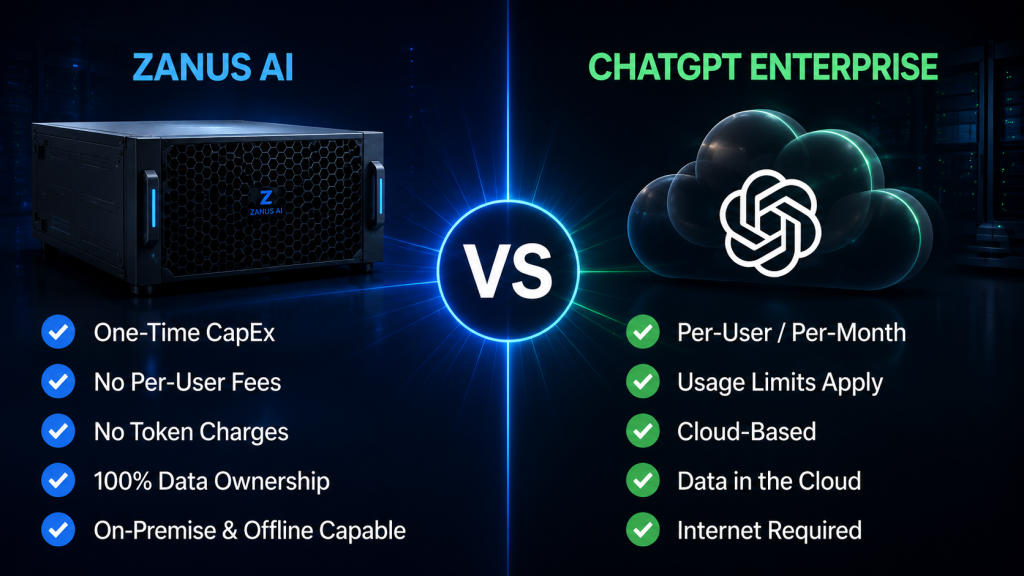
For an organization of roughly 150 users over 3 years, ChatGPT Enterprise costs could reasonably reach $300,000+ (based on the ~$108,000/year floor, before accounting for possible price increases). A Zanus AI Quantum or Enterprise Cluster configuration sized for a comparable organization — based on the third-party estimates in Section 3 — could carry a comparable or higher Year 1 cost, but Years 2–3 would consist only of maintenance and operations, with no scaling by user count.
This comparison is illustrative, based on estimates from multiple independent sources — not official quotes from Zanus AI or OpenAI. Actual figures depend on specific configuration, organization size, and contract negotiation timing. Request direct quotes from both vendors before deciding.
9. When Does Private AI Start Paying Off?
Short answer: once usage is large and stable enough that Private AI’s fixed operating cost undercuts the cumulative subscription/token cost of cloud AI over time.
A few factors that shape the break-even point:
- Number of users: per-seat cloud AI cost scales linearly with headcount; Private AI cost stays roughly fixed within the system’s capacity. The larger the organization, the bigger Private AI’s long-term cost advantage.
- Usage frequency and intensity: continuous, high-frequency AI use accumulates cloud token/seat costs faster.
- Workload stability: steady, 24/7 usage favors on-prem more than usage that swings heavily by season, since on-prem has to be sized for peak load — wasted capacity if the load isn’t stable.
- Compliance and security requirements: for industries required to control where data is processed (finance, healthcare, government), the decision isn’t purely about cost — Private AI can be effectively mandatory regardless of the break-even math.
- Internal operational capability: if a business already has (or is willing to build) an IT team capable of running the infrastructure, the added staffing cost for Private AI is far lower than outsourcing entirely.
Private AI doesn’t pay off for every business — for small teams with low, inconsistent usage, cloud AI remains the more economical choice. But for mid-size to large organizations with steady usage and the staff to operate the system, the cost curve tends to flip in Private AI’s favor somewhere between Year 2 and Year 3 of the TCO.
ThomasReview Verdict
“How much does Zanus AI cost?” doesn’t have a single answer — and that’s not unusual in the world of enterprise Private AI infrastructure. What matters more than the number is how the cost is structured: a large investment in Year 1, in exchange for predictable operating costs in the years after — the opposite of the climbing cost curve typical of seat- or token-based cloud AI.
Businesses evaluating Zanus AI should build their own 3–5 year TCO model based on actual team size and usage frequency, rather than comparing a server price against a monthly subscription price — the two numbers don’t sit on the same axis.
📖 Want to know if Zanus AI is actually worth the investment? Read the full breakdown: Zanus AI Review 2026 — Is It Worth Investing in for Businesses That Need Maximum Data Security?
All cost figures in this article come from third-party estimates or general industry benchmarks, not an official Zanus AI price list. Since Zanus AI only quotes on request, businesses should contact them directly for pricing accurate to their specific needs.
Sources
- Zanus AI official website — official hardware tiers, product specifications, and pricing structure (quote-based)
- ChatGPT Enterprise Pricing Guide (2026) — Beam Cloud — market-reported per-seat pricing range and seat minimums used for cost comparison
- Self-Hosted LLM Costs 2026 | Pricing Comparison — SitePoint — hardware amortization, electricity, and staffing cost benchmarks referenced for infrastructure cost estimates
- Self-Hosting LLMs: Hidden Costs You’re Missing — Azumo — engineering time and operational overhead figures used in the IT staffing and maintenance sections
