
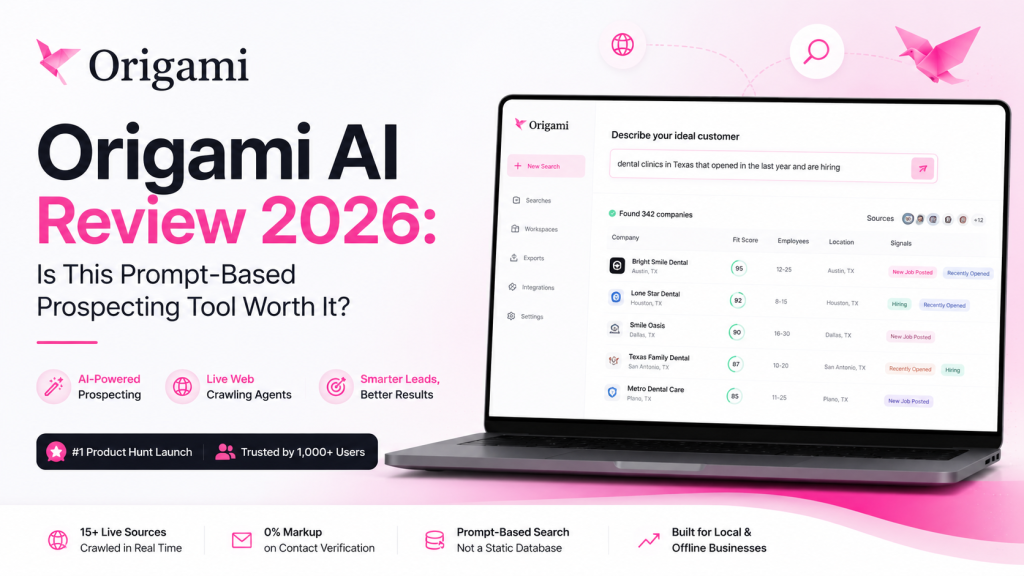
Quick Answer: Origami (origami.chat) is an AI-powered B2B prospecting platform that turns a plain-English prompt into an enriched lead list, using live web-crawling agents instead of a fixed database. Founded in 2024 (Y Combinator F24 batch), backed by a $2M seed round in January 2025, it launched publicly in February 2026 and hit #1 on Product Hunt within its first day. It’s strongest for local and offline verticals (HVAC, dental, home services) that database-led tools like Apollo and ZoomInfo tend to miss. Pricing runs from a free tier up to $499/month, with all paid plans charging a flat rate rather than per seat. Independent reviews are mixed but generally positive (3.7–4.7 out of 5 depending on the source), with the main criticisms being pricing transparency and a learning curve for writing effective prompts.
1. What Is Origami Ai?
Quick Answer: Origami is an AI-powered GTM (go-to-market) platform, founded in 2024 in San Francisco by Finn Mallery and Kenson Chung, that helps sales teams build and enrich B2B prospect lists using natural-language prompts instead of manual filters and spreadsheets.
The company joined Y Combinator’s Fall 2024 (F24) batch and announced a $2 million seed round in January 2025, with investors including Y Combinator, Pioneer Fund, and early angels such as Kaz Nejatian (COO of Shopify) and David Lieb (co-founder of Google Photos). It launched publicly on Product Hunt in February 2026, reportedly gaining over 1,000 signups with no paid marketing spend, and landed the #1 spot on launch day with 309 upvotes.
2. How Does Origami Work?
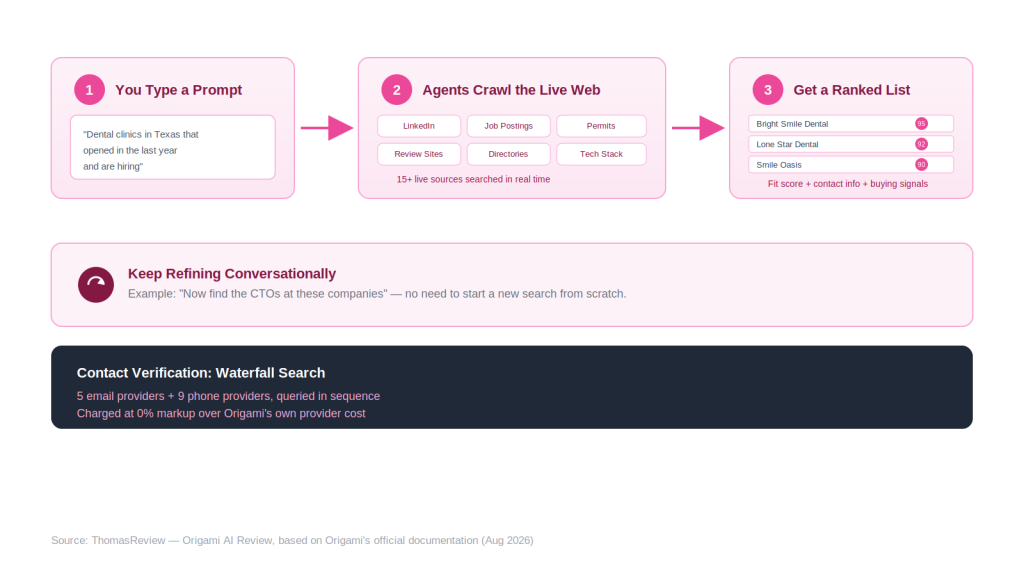
Quick Answer: Instead of searching a static, pre-indexed database, Origami deploys autonomous AI agents that crawl the live web in real time — pulling from LinkedIn, job postings, permits, review sites, local directories, and tech stack signals — based on a plain-English description of your ideal customer profile (ICP).
A typical workflow: you type a prompt like “dental clinics in Texas that opened in the last year and are hiring,” and Origami’s agents search across 15+ live sources (some sources cite 100+ depending on the query), then return a structured table of matching businesses with a fit score, contact details, and buying signals — new job postings, recent funding, leadership changes. You can keep refining conversationally, such as asking it to “now find the CTOs at these companies.” Results export to CSV or push directly into a CRM or sequencing tool.
For contact verification specifically, Origami runs a waterfall search (querying multiple data providers in sequence until a match is found) across 5 email providers and 9 phone providers, and states it charges contact verification at a 0% markup over its own provider costs.
3. What Makes Origami Different From Apollo or ZoomInfo?
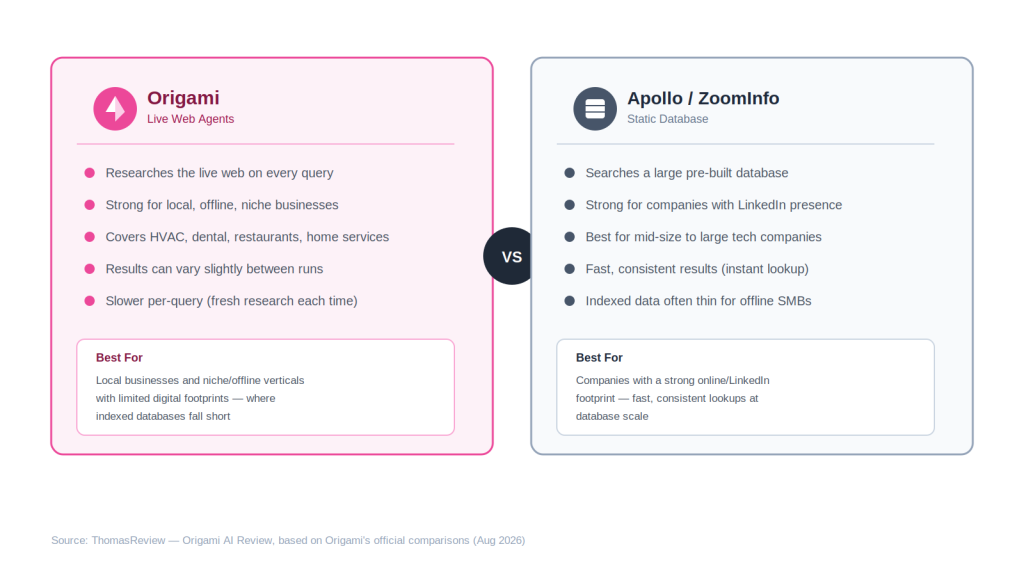
Quick Answer: The core difference is architecture: Apollo and ZoomInfo rely on large, pre-built databases of indexed LinkedIn and corporate profiles, while Origami’s agents research the live web on each query — which the company argues works better for local businesses, SMBs, and niche verticals with limited digital footprints.
This tradeoff cuts both ways. Database-led tools tend to return faster, more consistent results for companies with a strong online/LinkedIn presence — think mid-size to large tech companies. Origami’s live-crawling approach is reported to surface meaningfully more leads in offline verticals like HVAC, plumbing, restaurants, and medical practices, where Apollo/ZoomInfo’s indexed data is often thin. The tradeoff for that broader offline coverage is slower run times and more variability between searches, since each query triggers fresh research rather than an instant database lookup.
4. How Much Does Origami Cost?
Quick Answer: Origami has five tiers: a free plan, Starter at $29/month, Pro at $129/month (the vendor’s recommended plan), Scale at $499/month, and a custom Enterprise plan. All paid plans include unlimited team members with no per-seat fees, and are priced primarily by monthly credits, which are consumed as agents research and enrich leads.
| Plan | Price | Credits/Month | AI Model | Key Features |
|---|---|---|---|---|
| Free | $0 | 1,000 (one-time) | Origami 1.2 Lite | 20 messages to agent, 30 rows per table; no CSV export or contact reveal |
| Starter | $29/mo | 2,000 | Origami 1.2 Lite | 10 workspaces at once, free CSV export |
| Pro (Recommended) | $129/mo | 9,000 | Origami 1.2 Max | 20 workspaces, contact info (email/phone), unlimited sequencer |
| Scale | $499/mo | 40,000 | Origami 1.2 Max | 50 workspaces, dedicated Slack channel |
| Enterprise | Custom | Unlimited | — | SSO/SCIM, custom SLA, unlimited workspaces |
Pricing verified directly from origami.chat/pricing as of August 2026. The Free tier does not include CSV export or contact info reveal (email/phone) — those unlock starting at the Starter plan. Workspace counts above are concurrent-run limits, per Origami’s own pricing page: you can always create additional workspaces beyond that concurrent limit. Note: some press coverage from earlier in 2026 cited a flat $80/month price, which appears to be outdated — Origami has since moved to this five-tier, credit-based structure.
5. What Do Independent Reviews Say?
Quick Answer: Independent ratings for Origami are mixed but lean positive: Capterra shows 5.0/5, though from just one review, while ICON Polls rates it 3.7/5 and comparateur-ia reports 4.7/5 from 63 reviews. The most consistent praise is speed and coverage of offline/local verticals; the most consistent criticism is pricing clarity and the learning curve of writing effective prompts.
One recurring theme across third-party reviews: Origami is seen as a strong fit for startups and small-to-mid sales teams doing straightforward prospecting, but a weaker fit for enterprise teams needing deep workflow automation or complex multi-step enrichment pipelines — for those needs, reviewers point to tools like Clay or Bitscale instead.
6. What Are Origami’s Limitations?
Quick Answer: The most-cited limitations are result variability (since each search re-crawls the live web rather than hitting a fixed index), a steeper prompt-writing learning curve than filter-based tools, and thinner data coverage for enterprise/tech-heavy targets and international markets outside the US.
Origami’s own blog is fairly direct about these gaps: enterprise and tech coverage is thinner than Apollo’s for targeting Series B+ SaaS companies or large procurement teams, CRM syncs with Salesforce and HubSpot are described as still maturing, and Origami positions itself as a lead-generation tool rather than a complex multi-step waterfall enrichment platform — for that specific need, its own blog points to Clay as the better fit. International coverage is also noted as lighter outside major English-speaking markets. Worth noting: Origami does include a built-in email/LinkedIn sequencer with unlimited sends on paid plans, so outbound execution itself isn’t missing — the gap is more about coverage depth and enrichment complexity than missing features.
One point worth noting: according to Origami’s own blog, the platform does offer a REST API for developers — with documentation, a quickstart guide, and SDK samples available at docs.origami.chat — letting teams run the same live web-crawling prospecting and enrichment programmatically. (One third-party comparison review states otherwise, so if API access is a hard requirement, we’d still suggest confirming current availability and any tier restrictions directly with Origami before committing to a plan.)
ThomasReview’s Take
Origami’s core bet — that live web agents can out-perform static databases for offline and local businesses — lines up with a real gap in the market. Apollo and ZoomInfo are built around indexed LinkedIn and corporate data, which is exactly why they tend to underperform for HVAC companies, dental practices, or small regional businesses that don’t maintain a heavy digital footprint. If that’s your prospecting target, Origami’s approach is a genuinely different and potentially better-fit architecture, not just a UI wrapper on the same database model.
Where we’d temper expectations is around consistency and workflow depth. A tool that re-researches the web on every query will naturally produce more variable results than a static database lookup, and the pricing structure — while flat-rate and seat-free, which is a real advantage for collaborative teams — is tied to a credit system that’s worth modeling out against your actual query volume before committing to the Pro or Scale tier. And if your sales motion depends on complex, multi-step enrichment workflows or native outbound sequencing, the reviews are fairly consistent that Origami isn’t there yet.
7. Who Should Consider Origami?
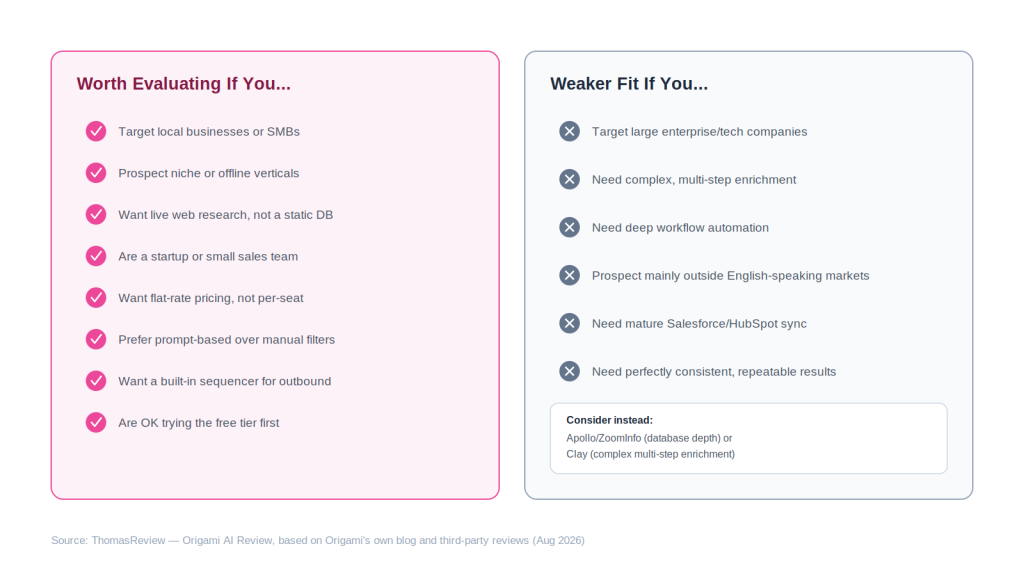
Quick Answer: Origami is worth evaluating for startups, founders, and small-to-mid B2B sales teams targeting local businesses, SMBs, or niche/offline verticals where Apollo and ZoomInfo’s database coverage is thin. It’s a weaker fit for enterprise sales teams needing deep workflow automation or native outbound execution.
For a closer look at how it stacks up against database-led alternatives, see our upcoming Origami vs. Apollo comparison.
Frequently Asked Questions
Is Origami the same as Origami Agents? Origami.chat is the consumer-facing product built by Origami Agents, the San Francisco startup founded by Finn Mallery and Kenson Chung.
Does Origami have a free plan? Yes. Origami offers a genuine $0 free tier (1,000 one-time credits, 20 messages to the agent, 30 rows per table) — not just a time-limited trial.
Is Origami cheaper than Apollo or ZoomInfo? It depends on the plan and how you count seats. Origami’s paid plans are flat-rate with unlimited team members, which can be cheaper for larger teams than per-seat pricing models — but you should compare actual credit usage against your team’s prospecting volume before assuming it’s less expensive overall.
Does Origami work well for enterprise tech companies? It can, but its strongest reported use case is offline and local verticals with limited digital footprints. Origami’s own blog notes its enterprise/tech coverage is thinner than Apollo’s for targeting Series B+ SaaS companies or large procurement teams, so enterprise tech buyers should weigh that gap directly.
ThomasReview Verdict
Origami is a genuinely different architectural bet on B2B prospecting, and the evidence so far backs up its strongest claim: real advantages in offline and local verticals that Apollo and ZoomInfo tend to under-serve. It’s not yet the strongest fit for enterprise teams targeting large tech companies or wanting deep multi-step enrichment, and live-crawling trades some consistency for that broader offline coverage. For startups and small sales teams prospecting local or niche markets, it’s worth a trial run on the free tier before committing to a paid plan.
Sources
- Origami official website — platform overview and features
- Origami pricing page — verified pricing as of August 2026
- Origami — Company page — founding team and company background
- Origami — Product Hunt launch recap — launch details and traction
- Origami — What Is Origami? (Origami blog) — REST API details and platform capabilities
- Origami Agents Secures Seed Funding — Origami Agents blog — $2M seed round announcement
- Y Combinator’s hottest startup, Origami Agents, secures $2M seed round — VentureBeat — funding round coverage
- Origami — Capterra — independent review data
- Origami.chat Review — ICON Polls — independent review (3.7/5)
- origami.chat Review — SyncGTM — waterfall enrichment details and third-party comparison
Disclaimer: Company claims regarding automation, data coverage, and results are based on Origami’s own materials and third-party reviews as of August 2026, and have not been independently audited by ThomasReview. Businesses should verify current pricing and features directly at origami.chat before making a purchasing decision.
