
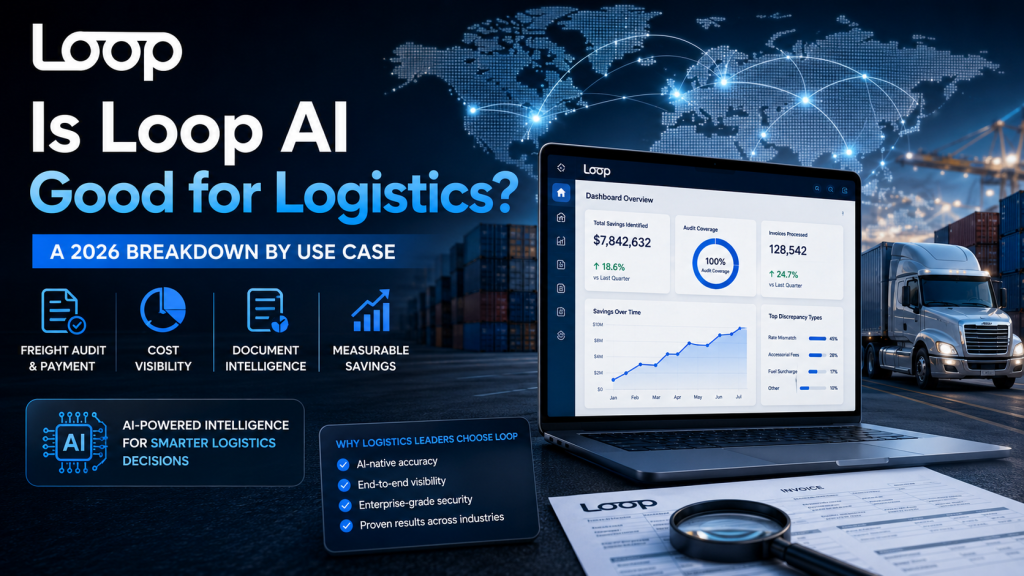
Quick Answer: Yes, for enterprise-scale logistics data and freight audit specifically — Loop AI is one of the more capable AI platforms currently built for logistics, with real customers across healthcare, food services, retail, and consumer goods reporting measurable savings. But “logistics” is a broad category: Loop is a data and audit intelligence layer, not a full transportation management system (TMS) or warehouse management system (WMS) replacement. It’s strongest for freight audit, cost visibility, and document-heavy back-office workflows — not for real-time route planning, fleet dispatch, or warehouse execution.
1. What Does Loop AI Actually Cover in Logistics?
Quick Answer: Loop’s core coverage centers on freight audit & payment (FAP), cost allocation, and exception management, and its DUX 2.0 data engine has expanded into customs and tariff document review, purchase order (PO) matching for inbound freight visibility, and audits of business-specific data fields.
Loop is also actively expanding its platform to connect with more of the logistics stack — including supplier data, trade and compliance data, warehouse data, procurement data, and inbound logistics data — while strengthening integrations with ERP (enterprise resource planning), TMS, WMS (warehouse management system), and order-management systems. The strategy is to build a single “source of truth” layer that other logistics systems can plug into, rather than replacing those systems outright.
2. Which Logistics Industries Is Loop AI Built For?
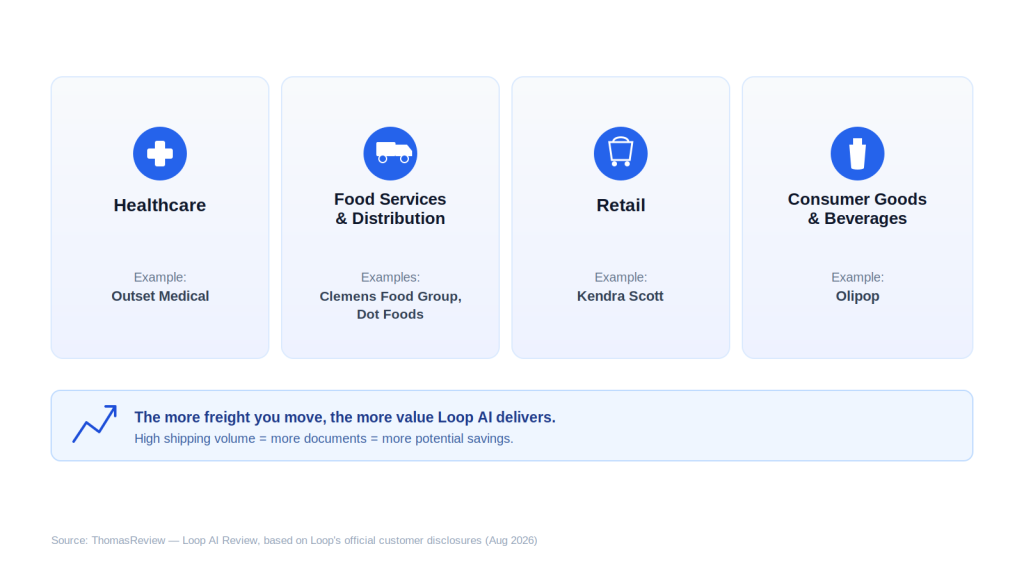
Quick Answer: Loop’s disclosed customer base spans healthcare, food services, retail, and consumer goods (CPG) — industries that typically ship high volumes across many carriers and generate large amounts of unstructured freight documentation.
Named customers include Outset Medical (healthcare), Clemens Food Group and Dot Foods (food services/distribution), Olipop (beverage/CPG), and Kendra Scott (retail). This spread suggests Loop is industry-agnostic within logistics, as long as the business ships at meaningful volume — the platform’s value comes from processing large amounts of freight documentation, so companies with low shipping volume are less likely to see the same return.
3. What Real Results Has Loop AI Delivered in Logistics?
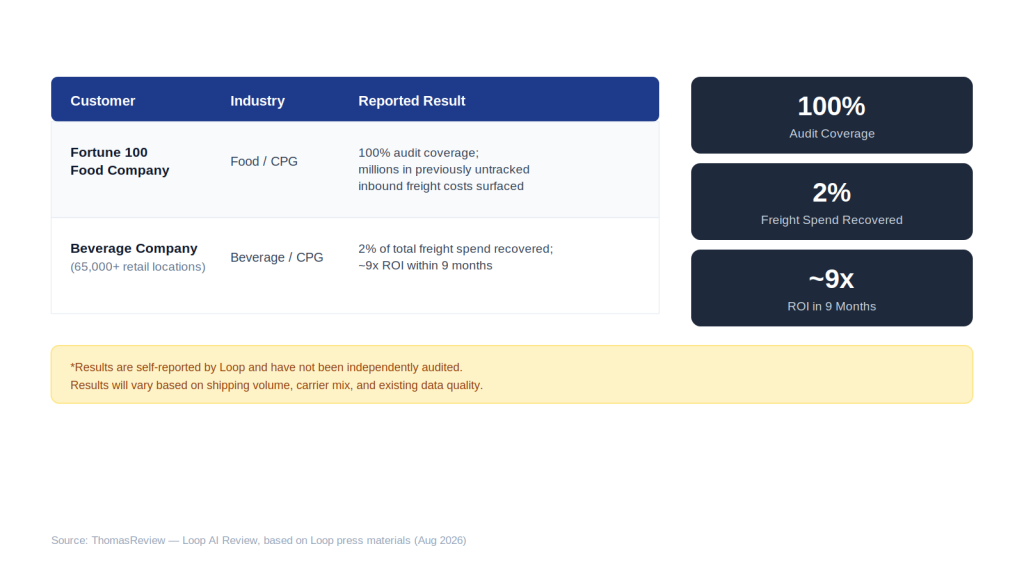
Quick Answer: Two independently reported case studies stand out: a Fortune 100 food company reached 100% audit coverage and uncovered millions in previously untracked inbound freight costs, and a beverage company shipping to over 65,000 retail locations recovered 2% of total freight spend and reached roughly 9x ROI within nine months.
| Customer | Industry | Reported Result |
|---|---|---|
| Fortune 100 food company | Food/CPG | 100% audit coverage; millions in previously untracked inbound freight costs surfaced |
| Beverage company (65,000+ retail locations) | Beverage/CPG | 2% of total freight spend recovered; ~9x ROI within 9 months |
Figures are self-reported by Loop in press materials and have not been independently audited. Results will vary based on shipping volume, carrier mix, and existing data quality.
4. What Loop AI Doesn’t Do
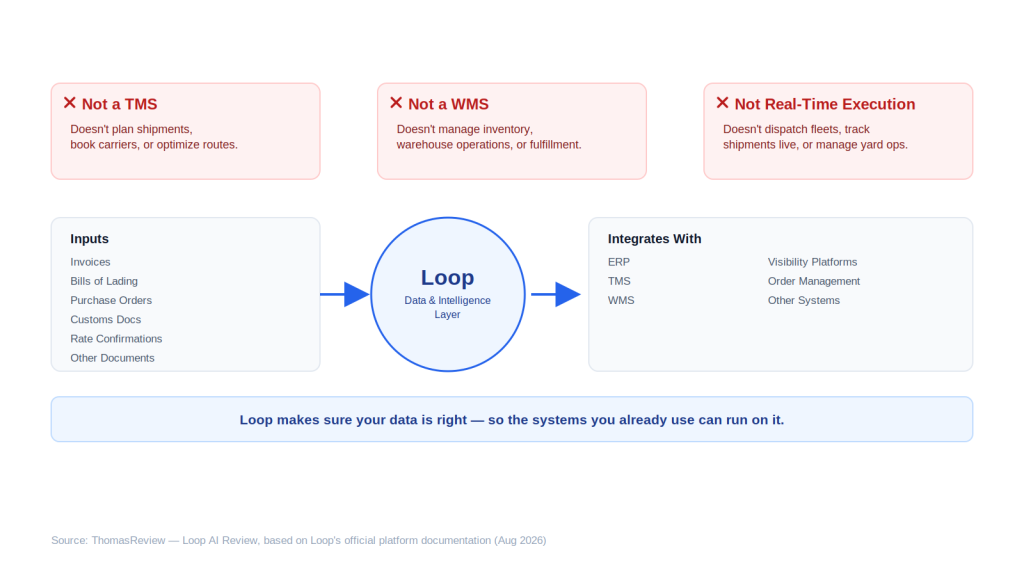
Quick Answer: Loop is not a TMS, WMS, or route-optimization tool — it doesn’t plan shipments, dispatch trucks, or manage warehouse inventory movement. It’s a data and intelligence layer that sits alongside those systems, focused on auditing, cost visibility, and turning unstructured documents into usable data.
This distinction matters if you’re searching for “logistics AI” broadly. If what you actually need is real-time route planning, fleet telematics, or warehouse pick-and-pack automation, Loop isn’t built to solve that — you’d be looking at a different category of software entirely (a TMS for route planning and carrier booking, a visibility platform like Project44 or FourKites for real-time shipment tracking, or a WMS for warehouse operations). Loop’s strength is specifically the financial and data-accuracy side of logistics: making sure invoices are correct, costs are visible, and previously messy documents become structured, usable information.
ThomasReview’s Take
The honest answer to “is Loop AI good for logistics” depends entirely on which part of logistics you mean. For the specific problem Loop was built to solve — turning fragmented freight and customs documents into clean, auditable data, and catching billing errors most human teams miss — the evidence so far is genuinely strong: real named customers, a repeatable results pattern (high audit coverage, measurable freight-spend recovery), and a product roadmap that’s expanding sensibly into adjacent document-heavy problems like customs and PO matching rather than chasing every logistics buzzword at once.
Where we’d caution shoppers is scope creep in expectations. Loop’s own marketing increasingly uses broad language like “full-stack AI platform for logistics and supply chains,” which can read as more comprehensive than what it currently does well. Ask specifically what “logistics” means in your sales conversation — audit and data accuracy, or shipment planning and execution — before assuming the platform covers everything the label implies.
5. Who Should Consider Loop AI for Logistics?
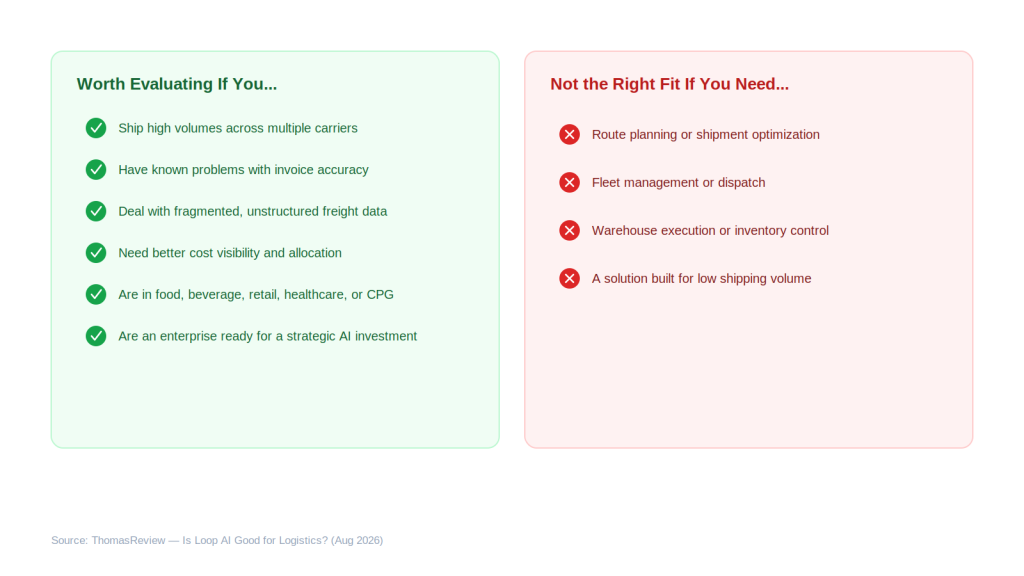
Quick Answer: Loop is worth evaluating for enterprise shippers — especially in food, beverage, retail, healthcare, and consumer goods — with high shipping volume, multiple carriers, and known problems with invoice accuracy or fragmented documentation. It’s not the right tool if what you need is route planning, fleet management, or warehouse execution software.
For a full breakdown of pricing, technology, and independent reviews, see our Loop AI Review. If you’re also comparing freight audit specifically, see Loop AI vs Orca.
Frequently Asked Questions
Is Loop AI a replacement for a TMS (transportation management system)? No. Loop is designed to integrate with existing TMS, WMS, and ERP systems rather than replace them — it focuses on data accuracy, audit, and cost visibility, not shipment planning or execution.
Does Loop AI work for industries outside food, beverage, and retail? Yes — Loop’s customer list includes healthcare (Outset Medical) — but public case studies are currently concentrated in food, beverage, and retail, so buyers in other industries should ask for industry-specific references.
Is Loop AI good for small logistics operations? Not particularly. Loop’s value comes from processing high volumes of freight documentation and invoices; low-volume shippers are less likely to see meaningful ROI, and Loop’s enterprise sales model isn’t built around smaller accounts.
ThomasReview Verdict
For the specific slice of logistics Loop targets — freight audit, cost allocation, and document-heavy back-office work — the platform has real, reported results behind it and a customer base spanning multiple industries. It’s a strong option for enterprise shippers with that specific pain point, not a general-purpose logistics AI solution — know which one you’re buying before you get on a sales call.
Sources
- Loop official website — platform capabilities and use cases
- Loop Launches the Logistics Data Platform — BusinessWire — DUX 2.0 features and customer case studies
- Loop Raises $95M Series C — BusinessWire — customer list and platform expansion
- Loop Logistics Data Platform — Gartner Peer Insights — independent review data
Disclaimer: Customer results and platform capabilities described in this article are based on Loop’s own press materials and official website as of August 2026, and have not been independently audited. Businesses should request references relevant to their own industry and shipping volume before making a purchasing decision.
