
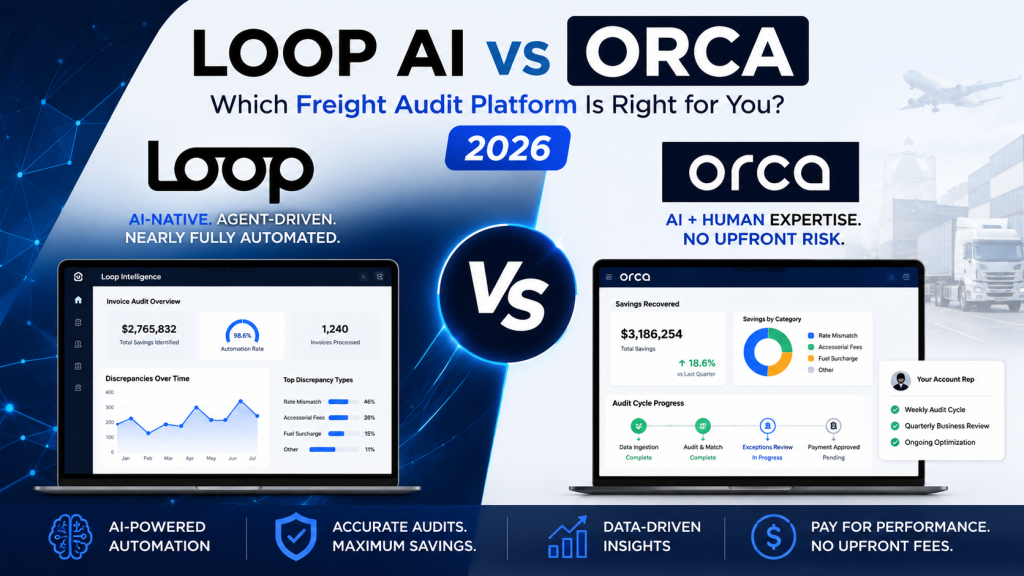
Quick Answer: Loop Ai and Orca Intelligence are both freight audit & payment (FAP — the process of verifying carrier invoices for billing errors before paying them) platforms, but they take opposite approaches. Loop is a newer (2021), AI-native platform built around its DUX agent, backed by $210M in funding, targeting large enterprise shippers. Orca is a more established (2016) provider that combines AI/ML with dedicated human audit reps and a pay-for-performance pricing model — you only pay a percentage of the savings it recovers, with no upfront fee. Orca has more independent reviews (4.3/5 from 14 ratings on Gartner Peer Insights) than Loop (4.5/5 from 2 ratings). If you want a proven, lower-risk pricing model, Orca is the safer starting point; if you want the most AI-forward, agent-driven audit experience and can absorb enterprise-contract pricing, Loop is worth evaluating.
1. Quick Note: “Orca AI” vs Orca Intelligence — Don’t Mix Them Up
Quick Answer: If you’re searching “Loop AI vs Orca AI,” there are two unrelated companies sharing the “Orca” name. The freight audit competitor to Loop is Orca Intelligence (orcaaudit.com), a Toronto-based freight audit and payment provider founded in 2016. Separately, Orca AI (orca-ai.io) is a Tel Aviv-based maritime AI company building collision-avoidance software for ships — a completely different product, market, and company. This article compares Loop with Orca Intelligence, the freight audit platform.
2. What’s the Core Difference Between Loop Ai and Orca?
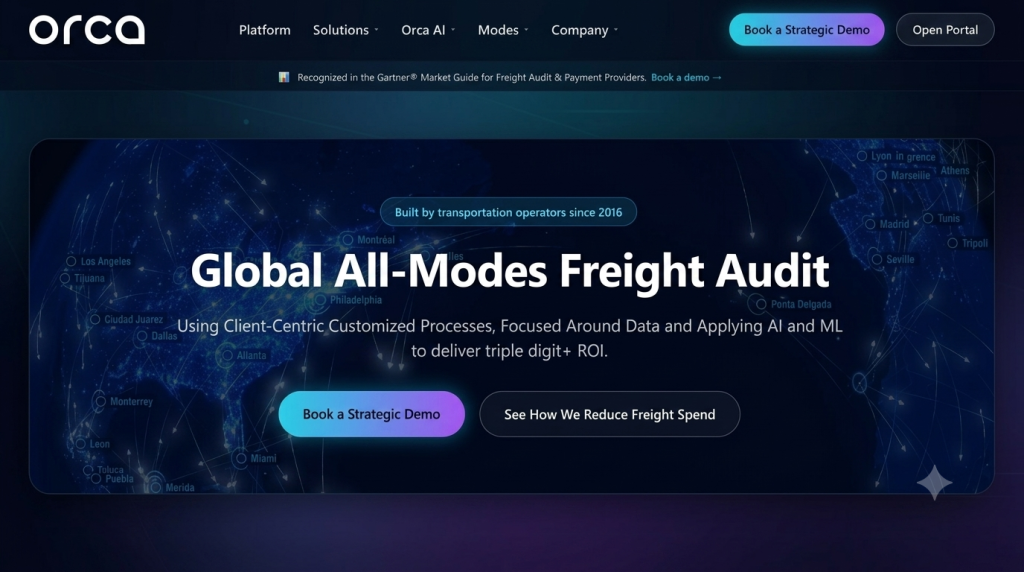
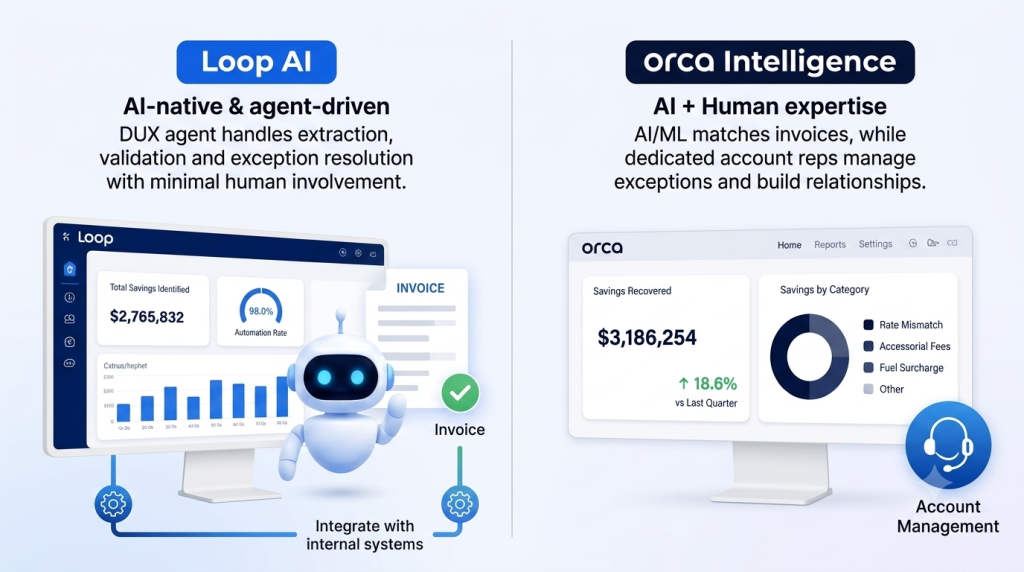
Quick Answer: Loop is AI-native — its DUX agent (a family of AI models trained specifically on logistics documents) handles extraction, validation, and exception resolution with minimal human involvement. Orca pairs AI/ML-driven invoice matching with a dedicated human account rep for every client, making it a hybrid automation model rather than a fully autonomous one.
Loop (Loop Payments Inc.), founded in 2021 in San Francisco, raised a $95M Series C in April 2026 ($210M total funding) and is used by Fortune 500 shippers like Olipop, Kendra Scott, and Dot Foods. Its core technology, DUX, reads and normalizes data from invoices, bills of lading, purchase orders, and customs paperwork, then takes action — such as automatically opening a carrier dispute when it finds a discrepancy. For the full breakdown, see our Loop AI Review.
Orca Intelligence, founded in 2016 in Toronto, Canada, processes over $5 billion in freight spend annually and audits invoices against contracted rates from hundreds of carriers every day. Orca says it automates roughly 96% of its operations, with the remaining share handled by dedicated account reps who run weekly audit cycles and quarterly business reviews with clients.
3. Loop vs Orca: Side-by-Side Comparison
| Criteria | Loop | Orca Intelligence |
|---|---|---|
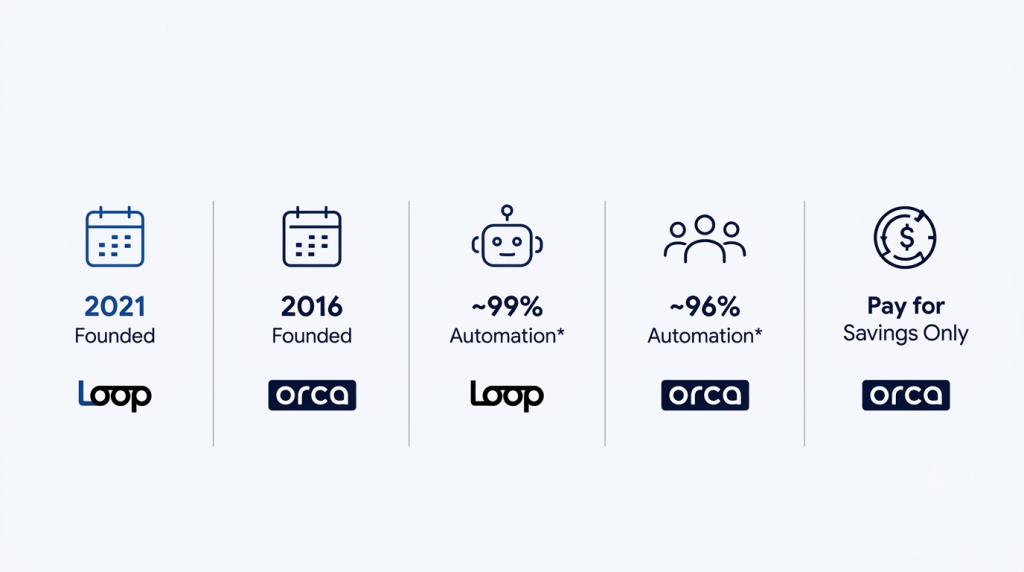
| Founded | 2021 (San Francisco) | 2016 (Toronto) |
| Core approach | AI-native; DUX agent automates extraction, validation, and exception handling | AI/ML-assisted matching + dedicated human reps managing each account |
| Claimed automation level | ~99% of invoice audits (Loop’s own figure, unverified) | ~96% of operations (Orca’s own figure, unverified) |
| Pricing model | Not disclosed; enterprise contract, custom quote | Percentage of savings recovered — no upfront or monthly fee |
| Funding | $210M total (Series C, April 2026) | Not publicly disclosed; privately held, 51–200 employees |
| Independent reviews (Gartner) | 4.5/5 (2 ratings) | 4.3/5 (14 ratings) |
| Notable extras | Loop Intelligence (natural-language data queries), Exception Agent for autonomous disputes | SKU-level landed cost analysis, quarterly business reviews with account reps |
| Best fit | Large enterprise shippers wanting the most automated, agent-driven audit stack | Shippers wanting a proven vendor and a pricing model with no upfront financial risk |
Table compiled from Gartner Peer Insights, Loop’s and Orca’s official websites, and press coverage as of August 2026. Both companies’ automation percentages are vendor-reported and have not been independently audited.
4. How Do Loop and Orca’s Pricing Models Differ?
Quick Answer: Orca’s savings-based model means you only pay based on what it recovers for you, with no upfront or monthly fee — your downside is capped. Loop uses a traditional enterprise contract with pricing that isn’t published anywhere, so you’re negotiating cost before you’ve seen results.
With Orca, if the platform doesn’t find savings, you’re not paying much — though you should still confirm exact fee percentages and any minimum commitments during a demo. With Loop, the burden of due diligence shifts more to you: ask about pilot terms, performance guarantees, or a smaller initial deployment scope before signing a longer contract.
5. Which Platform Has More Proven Reliability?
Quick Answer: Orca currently has the stronger independent trust signal: 14 Gartner-verified ratings averaging 4.3/5, compared with Loop’s 2 ratings averaging 4.5/5. More reviews mean more data points across different customers and use cases — Loop’s higher average is a promising early signal, but it’s based on too small a sample to call it a settled track record.
ThomasReview’s Take
The honest framing here isn’t “which platform is better” — it’s “which risk are you more comfortable taking on.” Loop is betting on a genuinely different technical approach: an AI agent (DUX) that reads, normalizes, and acts on logistics data with far less human involvement than a traditional audit team. If that bet pays off at your scale, you get faster exception resolution and a more autonomous back office. But you’re adopting that bet with less independent evidence behind it and without knowing the price going in.
Orca is the more conservative choice by design — its pay-for-performance model was clearly built to reduce the buyer’s risk, and a decade of operating history plus 14 verified reviews gives you more to check before signing. The tradeoff is a heavier reliance on human reps for consistency, which can be a feature (a known point of contact) or a limitation (less scalable automation) depending on how you look at it.
If we were advising a mid-to-large shipper today, we’d suggest running the numbers both ways: ask Orca for a savings estimate under its existing model, and ask Loop for a pilot scope with a defined evaluation period and clear exit terms before any long-term commitment. Don’t let either vendor’s automation percentage — 99% or 96% — be the deciding factor on its own; neither figure is independently verified, and real-world exception rates depend heavily on your specific carrier mix and invoice complexity.
6. Which Should You Choose?
Quick Answer: Choose Orca if you want a lower-risk entry point, a dedicated human point of contact, and a longer track record with more independent reviews. Choose Loop if you’re a large enterprise shipper ready to commit to an enterprise contract in exchange for the most AI-forward, agent-driven audit experience currently on the market.
Neither is a bad choice on the surface-level data — the right pick depends more on your organization’s risk tolerance and how much you value automation depth versus proven, human-backed consistency.
📌 Related Reading: For the full technical and pricing breakdown of Loop’s platform, see our Loop AI Review. Comparing enterprise AI more broadly? See our Zanus AI Review.
Frequently Asked Questions
Is Orca the same company as Orca AI (the maritime company)? No. Orca Intelligence (freight audit, Toronto) and Orca AI (maritime collision-avoidance software, Tel Aviv) are two unrelated companies that happen to share a name.
Does Loop or Orca have a free trial? Neither publicly advertises a self-serve free trial. Both require a sales conversation or demo request to scope pricing and terms.
Which platform is more established? Orca Intelligence, founded in 2016, has a longer operating history than Loop (founded 2021) and a larger base of independent Gartner reviews (14 vs. 2 ratings).
Can I use Loop or Orca without switching my existing ERP/TMS? Both platforms are built to integrate with existing ERP (enterprise resource planning) and TMS (transportation management system) software rather than replace them — but confirm specific integration compatibility with each vendor directly, since this varies by your existing tech stack.
ThomasReview Verdict
Loop and Orca solve the same problem — freight invoice accuracy — from opposite directions: Loop leads with autonomous AI and asks you to trust an enterprise contract you can’t see the price of upfront; Orca leads with a proven, risk-capped pricing model built on a decade of track record. There’s no universally “better” answer here — only a better fit for your organization’s risk tolerance and how much weight you put on automation depth versus proven consistency.
Sources
- Loop official website — company, product, and DUX platform information
- Orca Intelligence official website — company and pricing model information
- Orca Freight Audit and Payment Providers — Gartner Peer Insights — independent review data (4.3/5, 14 ratings)
- Loop Logistics Data Platform — Gartner Peer Insights — independent review data (4.5/5, 2 ratings)
- Orca Intelligence — Crunchbase profile — founding year and company details
- Press coverage of Loop’s April 2026 Series C funding round (TechCrunch, FreightWaves, SiliconANGLE)
Disclaimer: Automation percentages, pricing structures, and review scores in this article come from vendor websites, Gartner Peer Insights, and press coverage as of August 2026, and are subject to change. Businesses should verify current pricing and terms directly with each vendor before making a purchasing decision.
