
Quick Summary
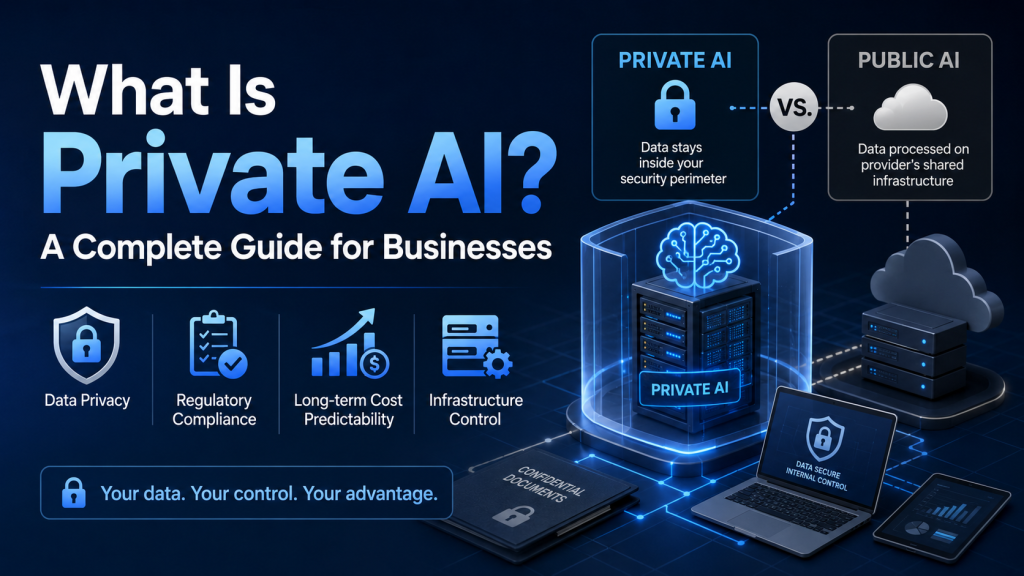
- Private AI is a deployment model where data is processed entirely within infrastructure a business owns or controls, rather than being sent to a third-party’s servers.
- Unlike Public AI (ChatGPT, Gemini’s consumer tiers) — where data passes through a provider’s shared infrastructure — Private AI keeps data inside the business’s own security perimeter.
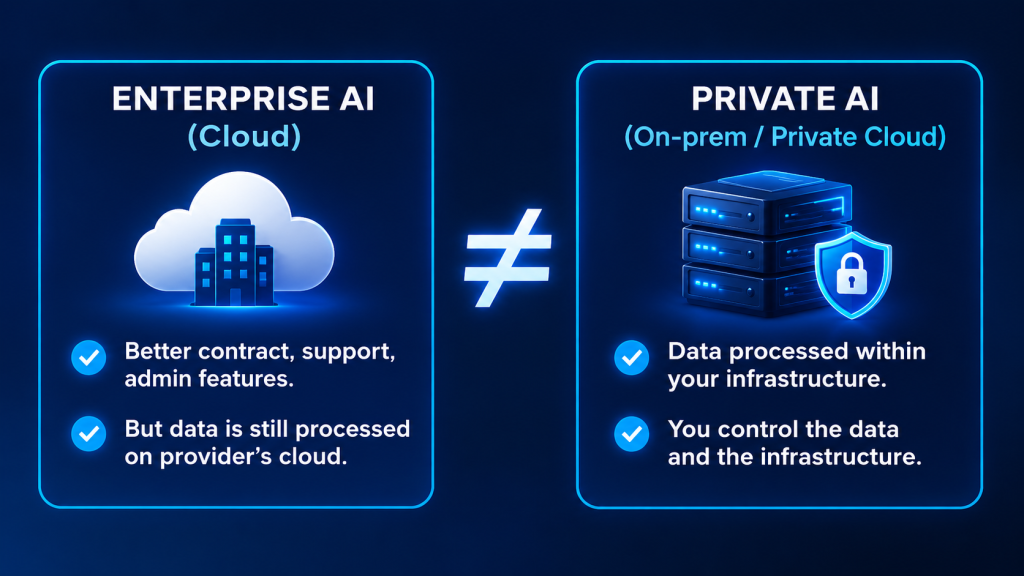
- Private AI is not the same thing as Enterprise AI. An “Enterprise” product (like ChatGPT Enterprise) can still be cloud-based; the difference lies in the contract and data policy, not in where the data is actually processed.
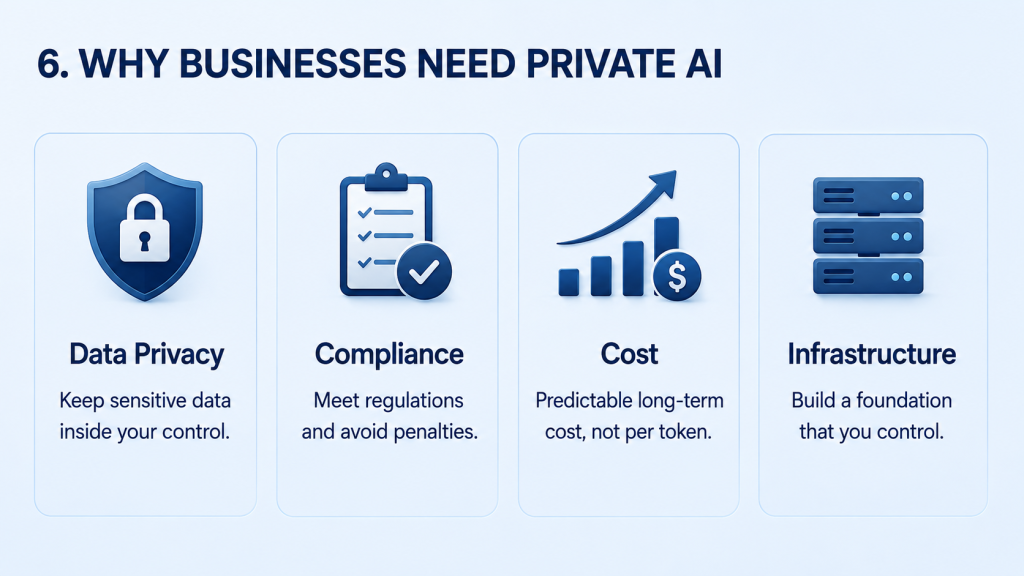
- Businesses turn to Private AI for four main reasons: data privacy, regulatory compliance, long-term cost predictability, and infrastructure control.
1. What Is Private AI?
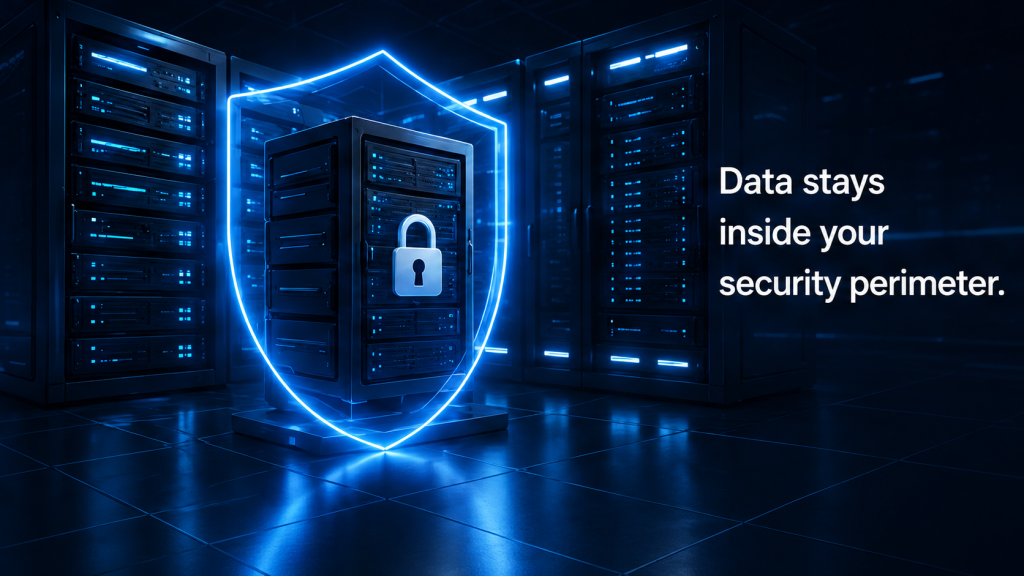
Private AI is a deployment approach — usually for large language models (LLMs) — where all data processing happens within infrastructure the business owns or leases: on-premises servers, a private cloud, or a dedicated (single-tenant) cloud tenancy. Data never travels to an external AI provider’s shared servers.
Industry sources (HPE, Cloudera, and various AI infrastructure vendors) generally define Private AI around three core traits:
- Data never leaves the business’s security perimeter.
- The business controls the model version, update schedule, and access permissions — none of it depends on the provider.
- Query logs, conversation data, and audit trails stay within the business’s own infrastructure.
Private AI is sometimes used interchangeably with two related terms: sovereign AI (which emphasizes the legal/jurisdictional angle — whose laws govern the data) and on-premises AI (which emphasizes the physical location of the infrastructure). The three concepts overlap but aren’t identical — Section 5 breaks this down further.
2. What Is Public AI?
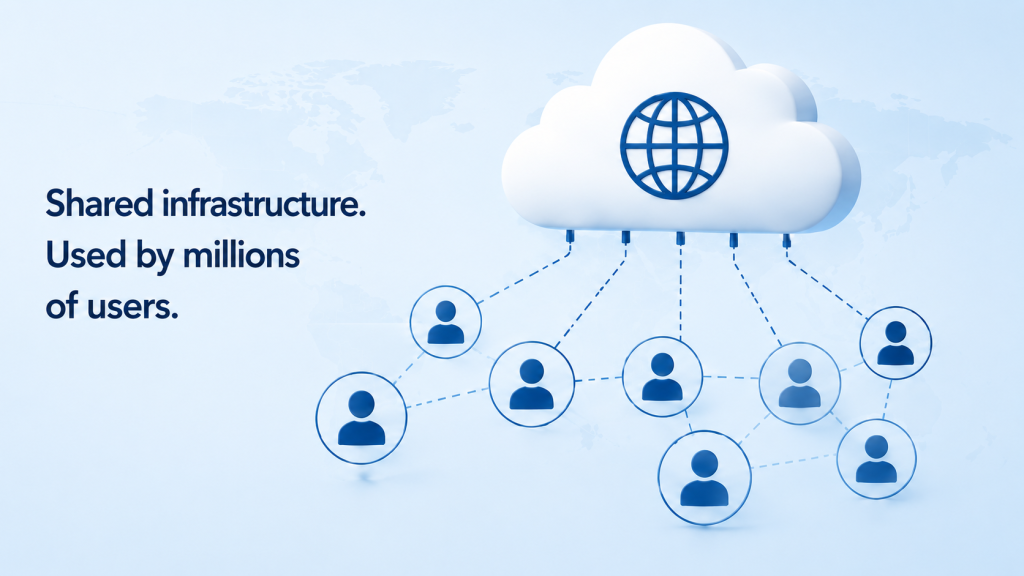
Public AI refers to AI services that run on a provider’s shared (multi-tenant) infrastructure, accessed through an API or a web/mobile app. Think free or Plus-tier ChatGPT, Gemini’s consumer version, or any AI chatbot used without a dedicated business contract.
Characteristics of Public AI:
- Data is processed on infrastructure shared with millions of other users.
- Data-usage policy (whether it’s used to train the model) depends on the provider’s terms of service, and can change over time.
- Pricing runs on subscriptions or pay-per-token — easy to adopt, no infrastructure investment needed.
- Well suited to individuals, small teams, or tasks that don’t involve sensitive data.
This isn’t “unsafe” in any absolute sense — for most individuals and small businesses, Public AI remains the most sensible choice on cost and speed of deployment. The problem only surfaces when a business handles customer data, financial records, health information, or intellectual property, where stepping outside internal control introduces legal or competitive risk.
3. Private AI vs. Public AI
| Criteria | Private AI | Public AI |
|---|---|---|
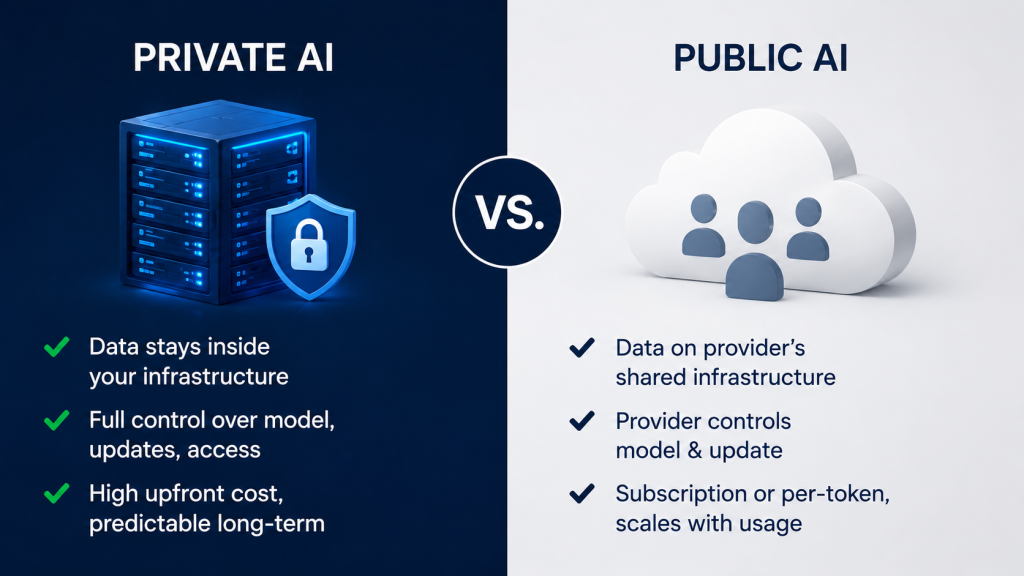
| Where data is processed | Infrastructure the business owns/controls | Provider’s shared infrastructure |
| Control over the model | Business decides version, updates, access | Provider decides |
| Cost | High upfront infrastructure investment; predictable long-term operating cost | Subscription or per-token; scales with usage |
| Deployment speed | Slower — infrastructure must be set up | Fast — usable immediately via account/API |
| Best suited for | Businesses handling sensitive data with strict compliance needs | Individuals, small teams, non-sensitive tasks |
| Examples | On-prem/private-cloud platforms, self-hosted open-source models | ChatGPT (personal tier), Gemini (consumer tier) |
The real distinction isn’t “which AI model is smarter” — it’s who controls the data and the infrastructure that processes it.
4. Private AI vs. Enterprise AI
This is the point that trips up even people working in tech.
Enterprise AI refers to AI packages built for organizations — typically bundled with SLAs, dedicated support, group-level access controls, and stronger contractual/security commitments than a personal-tier product. But Enterprise AI isn’t automatically Private AI.
Case in point: ChatGPT Enterprise and Claude Enterprise are still cloud-based services — data is still processed on OpenAI’s or Anthropic’s infrastructure. What changes versus the personal tier is the business contract, a stricter data policy (for example, a commitment not to use customer data for model training), and added admin features — not where the data is actually processed.
Put simply:
- Enterprise AI answers: Is this package right for our organization (contract, support, user administration)?
- Private AI answers: Where is the data processed, and who controls that infrastructure?
A business can use Enterprise AI (cloud) without it being Private AI, or run Private AI without any “Enterprise” package at all if it self-hosts an open-source model. This distinction matters when working with legal or compliance teams, since data-residency requirements aren’t satisfied simply by buying a cloud provider’s Enterprise plan.
5. What Is On-Premises AI?
On-premises AI (on-prem) is a specific form of Private AI, where the infrastructure — servers, GPUs, storage — physically sits in a data center the business owns or leases itself, rather than in a public cloud provider’s data center.
Three terms that often get conflated:
- Private AI: the broad concept — data processed within a boundary the business controls, whether that’s on-prem, private cloud, or a dedicated cloud tenancy.
- On-premises AI: one way of implementing Private AI, defined by physical location — infrastructure sitting inside the business’s own data center.
- Data residency vs. data sovereignty: a provider promising “your data stays in Europe” (data residency) isn’t the same as that data being beyond the reach of other countries’ laws (data sovereignty). If the provider is still a US company, the data can remain subject to laws like the CLOUD Act. This is why some financial institutions and government agencies choose on-premises deployment instead of simply picking a closer cloud region.
On-premises requires upfront hardware investment and an operations team, but in exchange gives the business the highest level of control over where its data physically exists and who can access it.
6. Why Do Businesses Need Private AI?
6.1. Data Privacy
When a business sends customer data, contracts, financial records, or R&D materials to an external AI provider, that data leaves the business’s direct control. Even when a provider commits not to use the data for model training, the business still has to trust a third party’s policies and security infrastructure.
Private AI removes most of that risk: data never leaves a system the business can monitor and control directly.
6.2. Compliance
This is the strongest driver behind Private AI adoption in heavily regulated industries — finance, healthcare, government. A few legal frameworks worth knowing when deploying AI with sensitive data:
- GDPR (Europe): requires a clear legal basis for processing personal data, and restricts transfers outside the EU/EEA unless a valid mechanism is in place (Standard Contractual Clauses, Binding Corporate Rules, or an adequacy decision).
- EU AI Act: requires “high-risk” AI systems to maintain data governance, logging, and conformity assessments — penalties can reach tens of millions of euros or a percentage of global revenue.
- HIPAA (US, healthcare): requires protection of personal health information (PHI), typically requiring a Business Associate Agreement (BAA) with any third party that processes the data.
- PIPL (China) and the DPDP Act (India): impose their own additional restrictions on cross-border data transfers.
With Private AI, because data never leaves internal infrastructure, demonstrating compliance — data residency, audit trails, access controls — is considerably simpler than evaluating the policies of every external cloud provider individually.
Note: regulations change over time and vary by region and industry. Businesses should consult their own legal/compliance team rather than relying solely on this article.
6.3. Cost
Private AI isn’t automatically cheaper:
- Public/cloud AI: low upfront cost, subscription or pay-per-token — easy to start, but expenses grow with usage and headcount.
- Private AI (especially on-premises): significant upfront infrastructure investment (GPUs, servers, an operations team), but for organizations with a large user base and heavy AI usage, long-term operating costs tend to be more predictable since they aren’t tied to query or token volume.
In other words, Private AI is a long-term infrastructure decision, not a quick productivity tool to spin up. Businesses should estimate their break-even point based on expected user count and usage frequency before committing.
6.4. Infrastructure
Deploying Private AI means building or leasing the right infrastructure:
- Hardware: GPUs powerful enough for the job — VRAM capacity determines the largest model you can run, and processing speed determines response latency.
- The AI model itself: a self-hosted open-weight model, or a packaged enterprise AI platform.
- An operations team: unlike cloud services (where the provider handles operations), Private AI/on-premises needs an internal IT team or a managed partner to maintain infrastructure, update models, and monitor security.
- Data architecture: platforms using RAG (retrieval-augmented generation) need an internal document-indexing system, a vector store, and department-level access controls.
This is why Private AI tends to make more sense for mid-size to large organizations with the IT team or budget to build and maintain infrastructure, rather than for individuals or very small businesses.
7. Private AI in Practice: Common Examples
A few common Private AI deployment patterns (illustrative of the model, not a product ranking):
- Self-hosted open-source models: a business deploys an open-source language model on its own GPU infrastructure — full control, but full responsibility for operations, maintenance, and updates too.
- Packaged enterprise platforms deployed on-premises: vendors sell a bundle of AI software plus deployment services on the customer’s own infrastructure, reducing the burden of building from scratch.
- Dedicated/single-tenant cloud tenancy: data still lives on cloud infrastructure, but in an environment fully isolated for one organization, not shared with other customers — a hybrid between Private AI and cloud.
- AI embedded into existing operational systems: instead of a standalone chatbot, AI gets built into existing business processes (document management, internal CRM, workflow automation), running inside the same security boundary as those systems.
Industries leading Private AI adoption include banking and finance, healthcare, manufacturing (protecting technical documentation and SOPs), legal services, and government agencies — anywhere sensitive data and compliance requirements are top priorities.
8. Where Does Zanus AI Fit In?
Zanus AI is one concrete example of Private AI packaged as an enterprise platform. Rather than just a model running on a private server, Zanus AI combines an AI Server with an AI Operating System, deployed inside the organization’s own infrastructure.
A few notable ways Zanus AI applies the Private AI model:
- Internal data processing: business data is processed in an environment the organization controls, rather than sent to an external AI provider.
- Company Brain: an internal knowledge layer built from the business’s own documents, processes, and contracts — illustrating how Private AI isn’t just “more secure,” but can also understand business context better than a shared AI service.
- A different cost model than cloud AI: according to Zanus AI’s published information, the platform doesn’t charge based on tokens or query volume after deployment — reflecting the “infrastructure investment instead of subscription” trade-off covered in the Cost section above.
This is just one way Private AI can be implemented — not the only definition, and not representative of the entire market. Businesses evaluating a specific platform should weigh it against their own infrastructure needs, budget, and compliance requirements.
Looking for an enterprise Private AI platform? Read our Zanus AI Review:

So amazing 💥💥