
AI is changing how businesses create videos.
Just a few years ago, producing a simple training or explainer video required a camera, microphone, lighting setup, editing software, and hours of post-production work.
Today, AI video generators promise something very different.
With platforms like Synthesia, you can turn a script into a fully narrated video in just a few minutes.
That sounds impressive.
But the real question is:
Are AI-generated videos actually good enough to use in real business scenarios?
Instead of relying on marketing claims or online reviews, I decided to test Synthesia myself.
I ran two experiments:
- The same English script using two different avatars (one male and one female)
- A Vietnamese video to evaluate pronunciation, lip-sync accuracy, and natural speech delivery
After completing the tests, I compared my observations with independent reviews and feedback from real users on Reddit.
My conclusion is straightforward:
Synthesia is excellent at helping businesses create videos faster and at lower cost. However, today’s AI avatars are still not natural enough to fully replace humans in content that relies on emotion, trust, or authenticity.
What Is Synthesia?
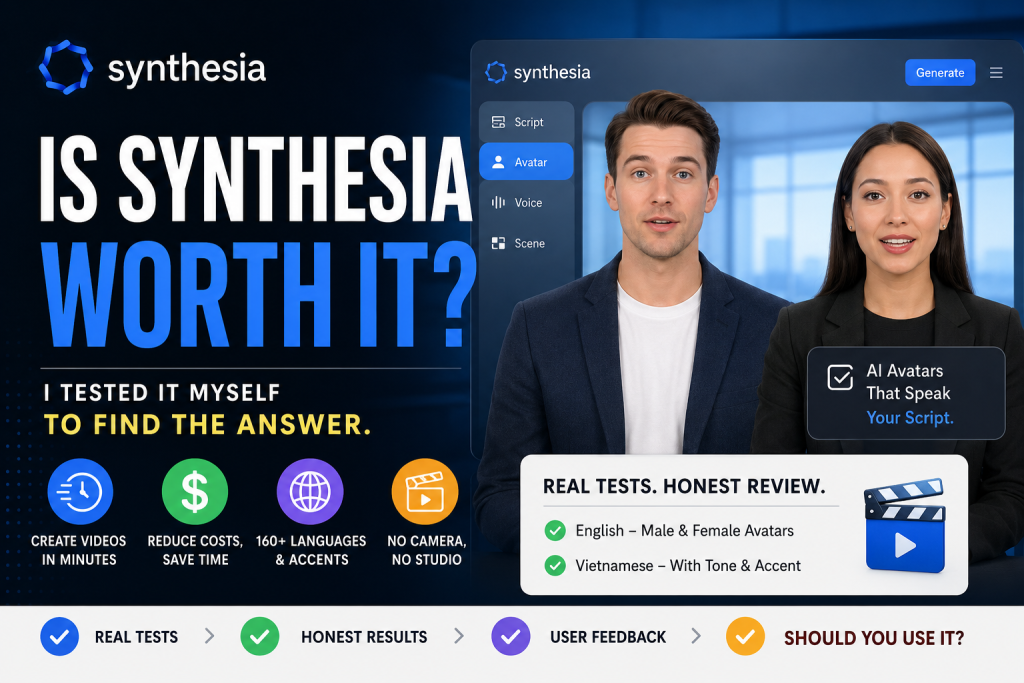
Synthesia is an AI video generation platform that converts text into videos featuring virtual presenters, also known as AI avatars.
The workflow is simple:
- Enter a script
- Choose an avatar
- Select a voice
- Click Generate
Synthesia automatically creates the voiceover, synchronizes lip movements, and renders a finished video.
According to the company, the platform supports hundreds of AI avatars and more than 160 languages and voices.
Its biggest selling point is obvious:
You can create presenter-style videos without cameras, microphones, actors, or editing software.
But speed alone doesn’t guarantee quality.
The real challenge is whether the final video feels convincing.
That’s what I wanted to find out.
Test #1: The Same English Script With Two Different Avatars
For the first experiment, I used the exact same English script and generated two separate videos:
- Male avatar
- Female avatar
My goal was to evaluate:
- Lip-sync quality
- Voice quality
- Facial expressions
- Overall realism
Video Demonstration
What I Observed
The first thing that stood out was the lip synchronization.
At normal viewing speed, it was difficult to spot any obvious mismatch between speech and mouth movement.
The voices were clear, easy to understand, and well paced.
However, several limitations became noticeable after watching for a few minutes:
- Facial expressions felt somewhat rigid
- Eye movements appeared unnatural
- Body movement was limited
- Certain gestures were repeated
Most importantly, I could immediately tell that I was watching an AI-generated presenter.
The avatars looked good.
They just didn’t look completely human.
Conclusion From Test #1
Synthesia has largely solved the technical challenge of synchronizing speech and lip movement.
The harder challenge—replicating natural human emotion and body language—remains unsolved.
In simple terms:
The avatars can communicate information effectively, but they still struggle to communicate emotion.
Test #2: Creating a Vietnamese Video
English is a useful baseline.
Vietnamese is a tougher challenge.
Unlike English, Vietnamese is a tonal language, which means pronunciation and intonation play a critical role in sounding natural.
Many AI voice systems still struggle with this.
Video Demonstration
What I Observed
The good news is that lip synchronization remained reasonably accurate.
The speaking pace was also stable and easy to follow.
However, compared with the English version, several weaknesses became more noticeable:
- Repetitive facial expressions
- Less natural movement
- Occasional pronunciation issues
- Stiff intonation in certain sentences
Most Vietnamese speakers would probably recognize the voice as AI-generated within the first few sentences.
Conclusion From Test #2
I would describe Synthesia’s Vietnamese support as usable for business content.
However, it is not yet at the point where it can fully replace a native speaker.
To be fair, this is not a Synthesia-specific issue.
Many AI voice platforms still struggle with tonal languages such as Vietnamese, Thai, and Chinese.
Do Other Users Have The Same Experience?
To avoid drawing conclusions from only two test videos, I compared my observations with independent reviews and community discussions.
Interestingly, most of the feedback aligned closely with what I experienced.
The strengths mentioned most often include:
- Fast video creation
- Reduced production costs
- Strong multilingual support
- Excellent use cases for training and corporate communication
The most common criticisms include:
- Avatars that still feel artificial
- The uncanny valley effect
- Occasional pronunciation issues
- Pricing that may be difficult to justify for individual users
Reddit discussions revealed a similar pattern.
Many users reported that the avatars sometimes feel slightly unnatural and can distract viewers from the actual content.
One observation appeared repeatedly:
Some users value Synthesia more for its AI voices than for its AI avatars.
That reinforces a conclusion I reached during testing:
Voice technology currently appears to be advancing faster than avatar technology.
What Synthesia Does Well
1. It Saves A Significant Amount Of Time
This is Synthesia’s biggest advantage.
During testing, I could generate multiple versions of a video simply by changing the avatar or editing the script.
With traditional production, that process could take hours or even days.
2. No Recording Equipment Required
You don’t need:
- Cameras
- Microphones
- Lighting
- Studio space
For many businesses, that alone can reduce production costs substantially.
3. Updating Content Is Easy
Need to change a product feature?
Update a training procedure?
Correct outdated information?
Simply edit the script and regenerate the video.
This is especially valuable for onboarding and training content.
4. Strong Multilingual Support
For companies operating internationally, multilingual content creation is one of Synthesia’s most compelling advantages.
Where Synthesia Falls Short
1. The Avatars Still Don’t Feel Completely Natural
This was the most obvious limitation across both tests.
The avatars look impressive at first glance, but subtle movements still reveal their artificial nature.
2. Emotional Expression Is Limited
The avatars can speak.
They cannot yet deliver the emotional depth, authenticity, and spontaneity of a real human presenter.
3. Vietnamese Support Is Good, But Not Perfect
Pronunciation and intonation issues still occur occasionally.
Depending on the audience, those imperfections may be noticeable.
4. Pricing Won’t Make Sense For Everyone
If you’re producing videos regularly, the value proposition is easy to justify.
If you’re creating only a few videos per month, the return on investment may be less convincing.
Who Should Use Synthesia?
Synthesia is a strong fit for:
- Employee training
- HR onboarding
- Customer Success teams
- SaaS companies
- Internal communications
- Product tutorials
- Multilingual educational content
These use cases share one common goal:
Delivering information clearly, consistently, and efficiently.
Who Should Probably Avoid It?
Synthesia may not be the best choice if your content depends heavily on human emotion and trust.
Examples include:
- Personal branding videos
- Customer testimonials
- Emotional storytelling
- High-impact advertising campaigns
- Trust-building sales content
In these situations, real people still have a significant advantage.
So, Is Synthesia Worth The Money?
After combining three sources of evidence:
- My own hands-on testing
- Independent reviews
- Real user feedback from Reddit
My answer is:
It depends on what you’re trying to accomplish.
If your goal is:
- Employee training
- Onboarding
- Product tutorials
- Internal communication
- Multilingual content production
Then Synthesia can absolutely provide value that justifies its cost.
However, if your goal is:
- Building trust
- Creating emotional connections
- Telling compelling stories
- Replacing a real human presenter
Then current AI avatar technology still has limitations.
🎵 Exploring AI Beyond Video?
Can AI actually create music that’s good enough for real-world projects?
After testing Synthesia for AI video generation, I wanted to see how far AI could go with music creation. So I put Suno AI through five hands-on tests and documented exactly what I found.
👉 Read next: Suno AI Review: I Tested 5 Features and Here’s What Creators Need to Know
Final Verdict
Before testing Synthesia, I thought the most important question was:
“Does the avatar look like a real person?”
After using the platform, I realized that’s the wrong question.
A better question is:
“Is the avatar good enough to get the job done?”
For training videos, onboarding materials, product tutorials, and internal communications, my answer is yes.
In both of my tests, Synthesia successfully produced complete videos with synchronized lip movements, clear narration, and a production workflow that was dramatically faster than traditional video creation.
At the same time, both my experience and feedback from the broader user community point to the same limitation:
AI avatars still cannot fully replicate the natural behavior, emotional expression, and trustworthiness of real people.
Synthesia is not a replacement for humans.
It is a tool that helps businesses produce videos faster and more efficiently.
If that’s how you evaluate it, Synthesia is absolutely worth considering.
If you’re expecting a virtual presenter that is indistinguishable from a real person, today’s technology hasn’t reached that point yet.
