
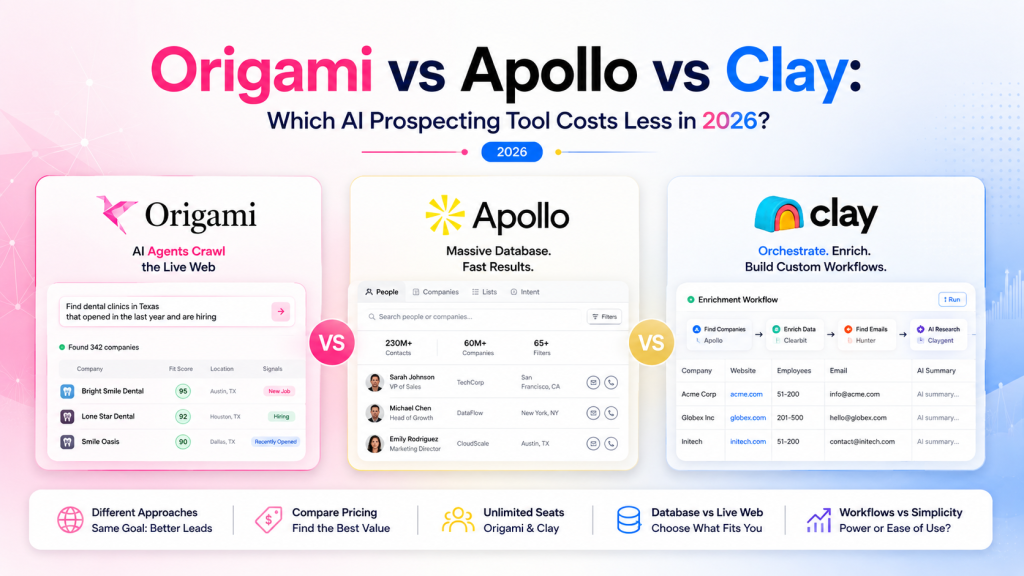
Quick Answer: These three tools aren’t quite apples-to-apples: Apollo is a static contact database ($49–$119/seat/month annual, or $69–$149 monthly), Origami is a live-web-crawling prospecting agent (flat $0–$499/month, unlimited seats), and Clay is a data orchestration platform that runs waterfall enrichment across 100+ providers, including Apollo itself (flat, usage-based, $0–$495+/month after a March 2026 repricing, unlimited seats). For straightforward prospecting on a budget, Origami’s flat rate is hardest to beat. For maximum database depth, Apollo wins. For complex, highly customized multi-step enrichment workflows, Clay is built for that — but it’s also the most expensive and technically demanding of the three.
This article refers to Clay (clay.com), the GTM (go-to-market) data orchestration platform — not to be confused with other companies using the Clay name, such as Clay.earth.
1. What Are These Three Tools, and How Do They Actually Differ?
Quick Answer: Apollo is a database company — it sells access to a pre-built index of 230M+ contacts. Origami is an AI agent company — it researches the live web on each query instead of maintaining a database. Clay is an orchestration company — it doesn’t have its own contact database at all, but instead runs waterfall searches (querying multiple providers in sequence) across 100+ third-party data sources, which can include Apollo, Clearbit, People Data Labs, and Hunter.io.
This distinction matters more than it sounds. Clay is often used alongside Apollo rather than instead of it — some teams pay for both, using Clay to orchestrate enrichment across Apollo’s data plus dozens of other providers in a single customizable workflow. Origami and Apollo, by contrast, are more directly substitutable: both are meant to be used on their own as a primary prospecting tool. For the full picture on Origami specifically, see our Origami AI Review, Origami vs Apollo, and Origami vs Clay comparisons.
2. Origami vs Apollo vs Clay: Pricing at a Glance
| Plan Tier | Origami | Apollo | Clay |
|---|---|---|---|
| Free | $0 — 1,000 one-time credits | $0 — unlimited email discovery (fair-use capped) | $0 — 100 Data Credits + 500 Actions/month |
| Entry paid | $29/mo — 2,000 credits/mo | $49/mo/seat (annual) or $69/mo/seat (monthly) | $185/mo (or $167/mo annual) — 2,500 Data Credits + 15,000 Actions/mo |
| Mid tier | $129/mo — 9,000 credits/mo | $79/mo/seat (annual) or $99/mo/seat (monthly) | $495/mo (or $446/mo annual) — 6,000 Data Credits + 40,000 Actions/mo |
| Top self-serve | $499/mo — 40,000 credits/mo | $119/mo/seat (annual, min 3 seats) or $149/mo/seat (monthly) | No third self-serve tier — jumps to Enterprise |
| Enterprise | Custom | Custom | Custom — commonly $30,000–$154,000/year |
| Pricing basis | Flat rate, unlimited seats | Per seat | Flat, usage-based (Data Credits + Actions), unlimited seats |
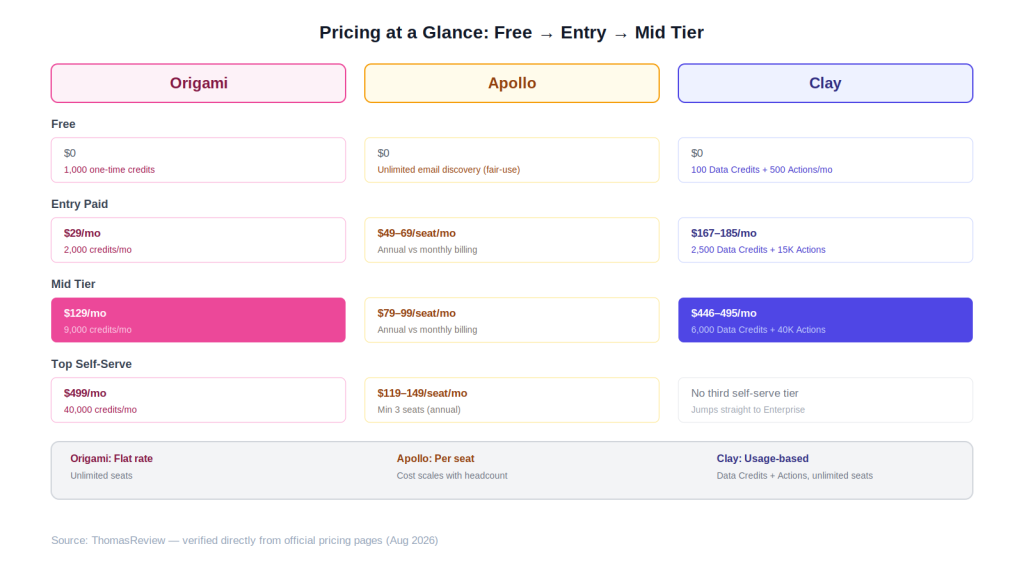
Table compiled from each vendor’s official pricing page as of August 2026. Clay overhauled its pricing structure in March 2026 — older third-party articles citing Clay’s previous Starter ($149), Explorer ($349), or Pro ($800) tiers are now outdated.
3. How Much Does Each Actually Cost Per Lead?
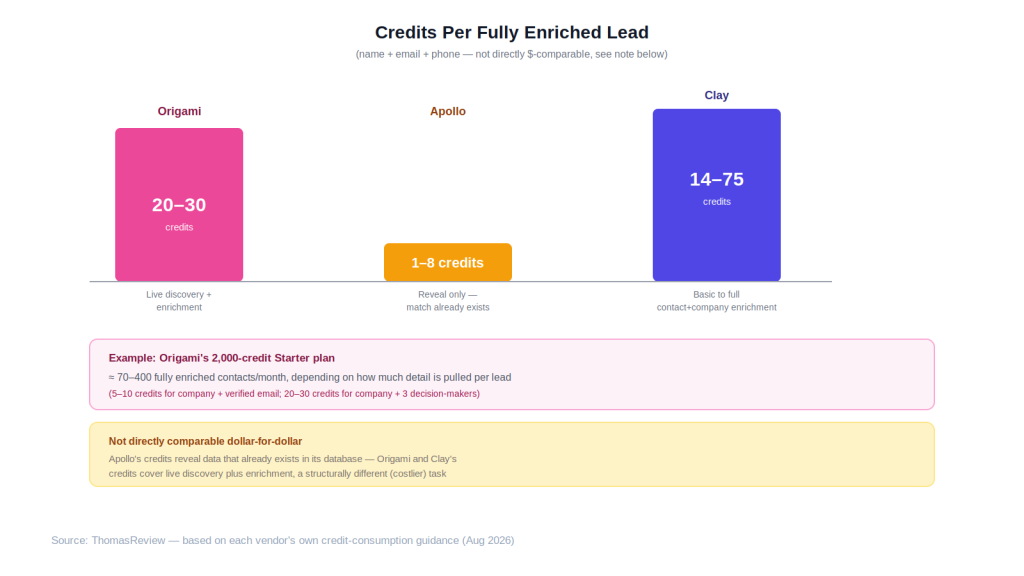
Quick Answer: Rough estimates, based on each vendor’s own credit-consumption guidance: a fully enriched contact (name, email, phone) costs approximately 20–30 credits on Origami, 1 credit for email-only or 8 credits for phone on Apollo (since Apollo’s database already contains the match — you’re paying to reveal it, not discover it), and 34–75 credits on Clay depending on enrichment depth. These aren’t directly comparable dollar-for-dollar, since Apollo’s credits cover reveal of existing data while Origami’s and Clay’s credits cover live discovery plus enrichment — a structurally different (and typically more expensive) task.
Working through Origami’s own published guidance: finding a company with a verified email runs roughly 5–10 credits, while finding a company plus 3 decision-makers with email and phone runs roughly 20–30 credits — meaning a 2,000-credit Starter plan translates to somewhere between 70 and 400 fully enriched contacts per month, depending on how much detail you’re pulling per lead. Clay’s published rates show basic contact enrichment at 14 credits and full contact-plus-company enrichment at up to 75 credits, with the caveat that Clay charges credits for every enrichment attempt — including ones where no data is found.
4. Which Has the Simplest (or Most Complex) Credit System?
Quick Answer: Origami runs the simplest system — one credit currency, spent on search and enrichment. Apollo splits usage into a general credit pool plus separate mobile/export credit allocations. Clay is the most complex: it runs two separate meters (Data Credits for third-party marketplace lookups, Actions for platform operations), with credit costs varying by which of its 100+ providers a given workflow queries.
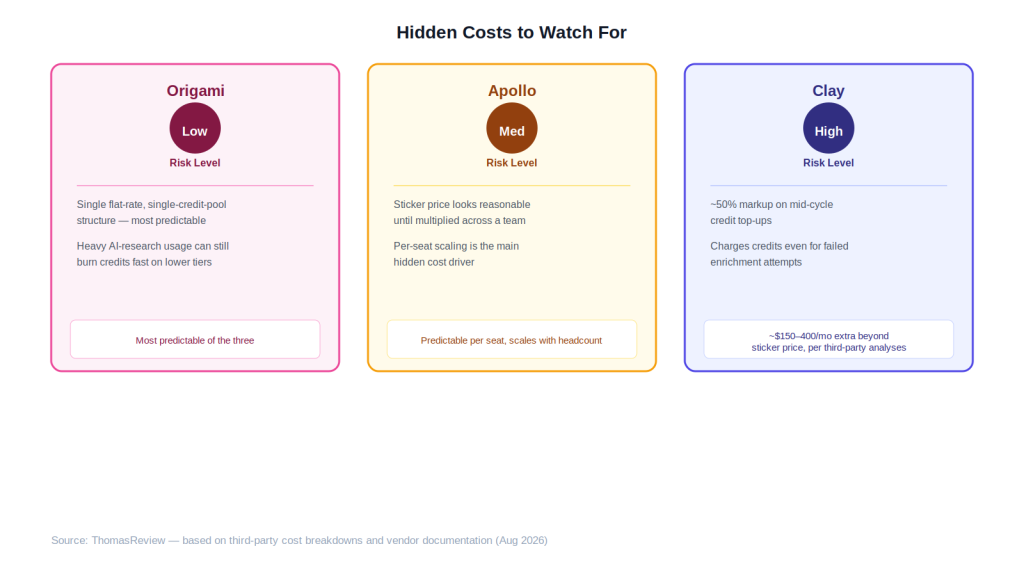
Clay’s dual-meter system is powerful for advanced users who want fine control over exactly which providers get queried, but it also means the “sticker price” on Clay’s pricing page understates real spend more than either competitor. Clay explicitly caps credit rollover at 2x your monthly allocation and charges a roughly 50% markup on top-up credits purchased mid-cycle — a cost structure that rewards teams who can forecast usage accurately and penalizes teams who can’t.
5. Total Cost of Ownership: Hidden Costs to Watch For
Quick Answer: Clay has the most-documented hidden-cost profile of the three: third-party analyses report typical additional spend of $150–$400/month beyond the sticker price once top-ups and provider passthrough costs are factored in. Apollo’s main hidden cost is per-seat scaling — the sticker price looks reasonable until you multiply it across a growing team. Origami’s flat-rate, single-credit-pool structure is comparatively the most predictable of the three, though heavy AI-research usage can still burn through credits faster than expected on lower tiers.
One point worth independent verification before committing budget: multiple third-party breakdowns describe Clay charging for failed enrichment attempts (queries that return no data still consume credits), which several reviewers flag as a source of unexpectedly high effective cost-per-successful-lead. This is a structural feature of Clay’s provider-waterfall model, not a bug, but it’s worth modeling into any cost comparison.
ThomasReview’s Take
The honest framing here is that these three tools aren’t really competing head-to-head for the same budget line — they’re solving different problems at different levels of complexity. Apollo sells you access to what it already knows. Origami sells you the ability to find what nobody has indexed yet, at a predictable flat rate. Clay sells you control — the ability to orchestrate exactly which providers get queried, in what order, for what data — and that control comes at a real cost premium and a steeper learning curve that several independent reviewers describe as taking weeks to master.
For most small-to-mid sales teams comparing sticker prices, Origami’s flat-rate simplicity is the easiest to budget for and forecast. Apollo makes sense once you know your accounts live in its database and want fast, proven lookups. Clay is the right tool specifically when you’ve outgrown a single-vendor approach and need to stitch together dozens of data sources into a custom pipeline — but budget meaningfully above the advertised price, since that’s the most consistent theme across independent Clay cost breakdowns.
6. Which Should You Choose?
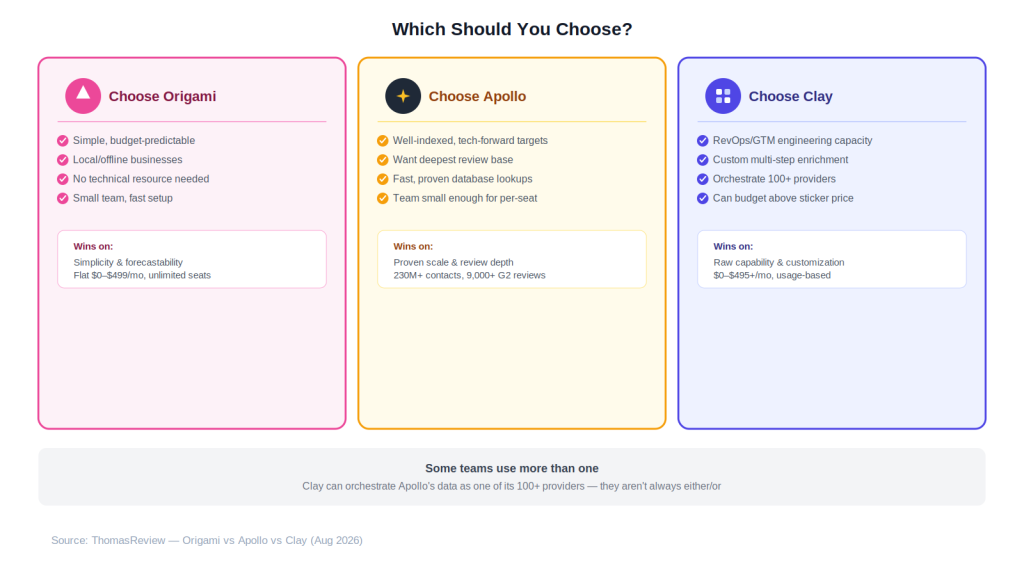
Quick Answer: Choose Origami for simple, budget-predictable prospecting focused on local or offline businesses. Choose Apollo if your targets are already well-indexed (mid-size to large tech companies) and you want the deepest independent review base. Choose Clay if you need to orchestrate enrichment across many providers in custom workflows and have the budget and technical patience for its learning curve — and consider that some teams end up paying for Clay and Apollo together, using Clay to orchestrate around Apollo’s database rather than replace it.
Frequently Asked Questions
Is Clay a replacement for Apollo, or does it work with Apollo? Both are possible. Clay can query Apollo’s data as one of its 100+ integrated providers, so some teams use Clay to orchestrate Apollo alongside other sources rather than choosing one or the other.
Which of the three is cheapest for a small team? For a small team (1–5 people) doing straightforward prospecting, Origami’s flat-rate plans are typically the least expensive of the three, since Apollo’s cost scales per seat and Clay’s entry paid tier ($185/month) starts well above Origami’s.
Does Clay have a free plan like Origami and Apollo? Yes, all three offer a free tier, though Clay’s (100 Data Credits + 500 Actions/month) is the most usage-limited of the three for real prospecting volume — reviewers generally describe it as enough to test the platform, not run a real campaign.
Why did Clay’s pricing change in 2026? Clay overhauled its self-serve pricing structure in March 2026, replacing its previous three-tier system (Starter/Explorer/Pro) with two tiers (Launch/Growth) and splitting its credit system into separate Data Credits and Actions. Businesses researching Clay should confirm they’re looking at post-March-2026 pricing.
ThomasReview Verdict
There’s no single cheapest option here — the right answer depends on what kind of prospecting problem you’re solving, and for Clay specifically, whether you’re budgeting for the sticker price or the realistic total including top-ups. Origami wins on simplicity and forecastability. Apollo wins on proven scale and review depth. Clay wins on raw capability for teams equipped to use it. Match the tool — or combination of tools — to your actual workflow complexity rather than comparing sticker prices alone.
Sources
- Origami pricing page — verified plan pricing
- Apollo.io official pricing page — verified plan pricing
- Clay pricing page — verified directly, including tier-specific actions/data credits
- Clay Pricing 2026 — Cleanlist — verified against clay.com/pricing, August 2026
- Clay Pricing Breakdown 2026 — Salesmotion — March 2026 pricing overhaul details
- Clay Pricing 2026: Hidden Costs & Real TCO — LaGrowthMachine — credit consumption and hidden-cost analysis
- Origami Reviews & Pricing for Startups — Origami blog — credit-to-lead consumption estimates
- Origami AI Review — ThomasReview — full Origami platform breakdown
- Origami vs Apollo — ThomasReview — direct Origami/Apollo comparison
- Origami vs Clay — ThomasReview — direct Origami/Clay comparison
Disclaimer: Pricing and credit-consumption figures in this article are drawn from each vendor’s official materials and third-party analyses as of August 2026, and are subject to change — particularly for Clay, which changed its pricing structure significantly in March 2026. Businesses should verify current pricing directly with each vendor before making a purchasing decision.
