
Quick Answer
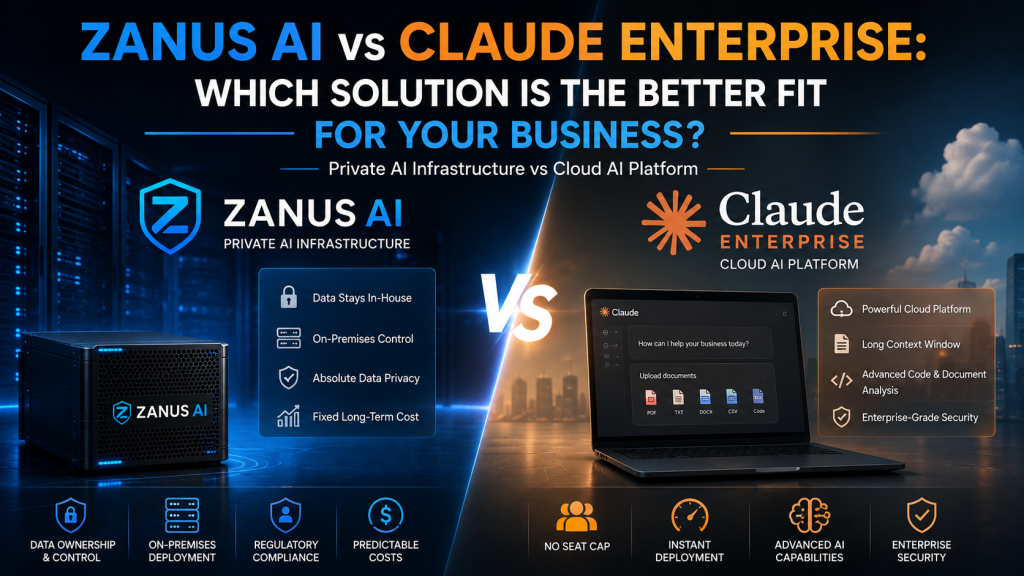
Zanus AI and Claude Enterprise serve two different needs. Claude Enterprise is a cloud AI platform built around long-document analysis, code, and enterprise-grade security governance (SSO, SCIM, audit logs) — a strong fit for businesses that want powerful text and code capability without managing infrastructure. Zanus AI is Private AI infrastructure deployed on-premises, built for businesses where data never leaving internal systems is a non-negotiable requirement.
| Criteria | Zanus AI | Claude Enterprise |
|---|---|---|
| Data Processing Location | Internal on-premises infrastructure | Anthropic’s cloud (with a US-only inference option) |
| Pricing Model | One-time CapEx purchase + annual maintenance | Seat fee ($20/user/month) + usage billed separately at API rates |
| Real-World Cost | ~$20,000–$150,000+ (third-party estimates) | Fixed seat cost, but usage varies — real-world spend often runs ~$60–$250+/user/month |
| Deployment Time | Approximately 3 weeks (vendor-claimed) | Nearly instantaneous (self-serve or sales-assisted) |
| Infrastructure Management | Internal IT team | Managed entirely by Anthropic |
| Standout Strength | Absolute data control, fixed long-term cost | Long context window, complex document/code handling, no seat cap |
1. What’s the Core Difference Between Zanus AI and Claude Enterprise?
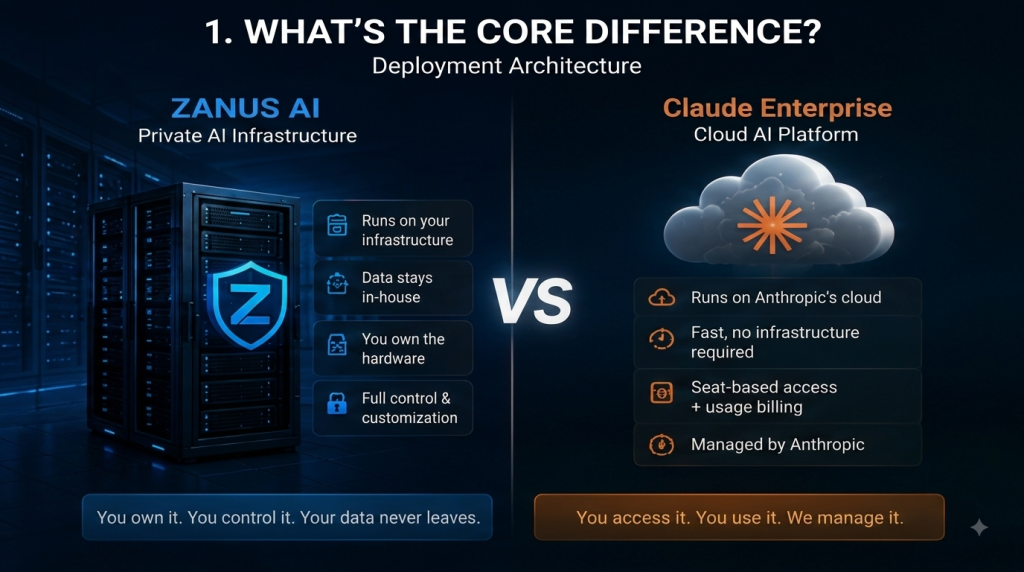
As with the ChatGPT Enterprise comparison, the root difference is deployment architecture: Zanus AI is infrastructure the business owns, while Claude Enterprise is a cloud service rented on a seat-plus-usage basis.
One structural detail sets Claude Enterprise apart from ChatGPT Enterprise, though: Anthropic separates the platform access fee (seat) from actual usage (billed at API rates). The seat fee only buys access — the real cost depends on which model (Opus, Sonnet, or Haiku) employees use and how much. That’s a meaningful distinction when weighing it against Zanus AI’s fixed-cost model.
2. Security and Data Ownership Compared
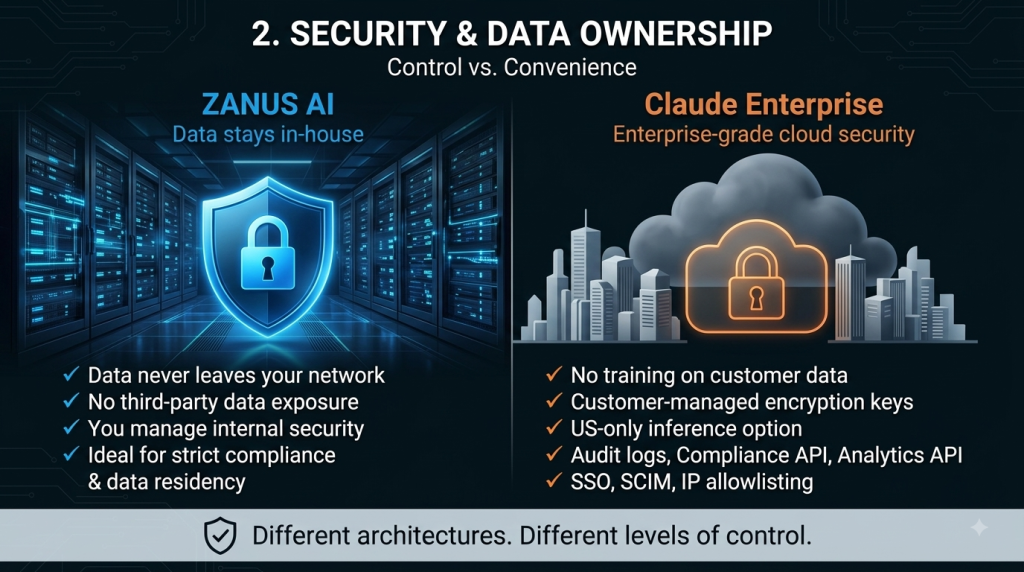
Quick Answer: Claude Enterprise doesn’t train its models on customer data, and supports customer-managed encryption keys plus a US-only inference option — strong contractual and technical controls, but the data still gets processed on Anthropic’s infrastructure. Zanus AI keeps data entirely in-house, removing this issue at the architecture level.
Claude Enterprise — key security aspects (per Anthropic’s official documentation):
- No training on customer data: this commitment applies to both the Claude Platform (API) and Claude Enterprise.
- Visibility and logging: audit logs, a Compliance API (programmatic access to activity logs, chat history, and file content, filterable by user and time range), and an Analytics API for aggregated usage data — designed to feed into the DLP and SIEM tools security teams already run.
- Customer-managed encryption keys: the business provisions its own encryption key on its own cloud provider, and Anthropic uses that key to protect chats, projects, and files — a form of control that edges closer to genuine data ownership than default encryption.
- US-only inference: keeps all inference processing within US territory — useful for organizations with data-location requirements that fall short of requiring full on-premises deployment.
- Network controls: IP allowlisting and network-level access control can block access to personal or non-corporate Claude instances from the enterprise network — reducing the “shadow AI” risk covered in our ChatGPT Enterprise comparison.
- SSO and SCIM for centralized access management, meeting standard enterprise security requirements.
On Zanus AI, as covered in our other comparisons, data never leaves internal infrastructure, which removes the risk tied to data leaving the building entirely — in exchange, the business is responsible for securing that infrastructure itself.
Bottom line: Claude Enterprise offers a fairly comprehensive set of contractual and technical data controls — customer-managed keys and US-only inference in particular — that meaningfully narrow the gap with Private AI compared with typical cloud AI platforms. But for industries where data must never cross a physical internal boundary under any circumstances (certain finance, defense, or government requirements), only an on-premises architecture like Zanus AI’s fully satisfies that bar.
3. Cost Comparison: Zanus AI vs. Claude Enterprise
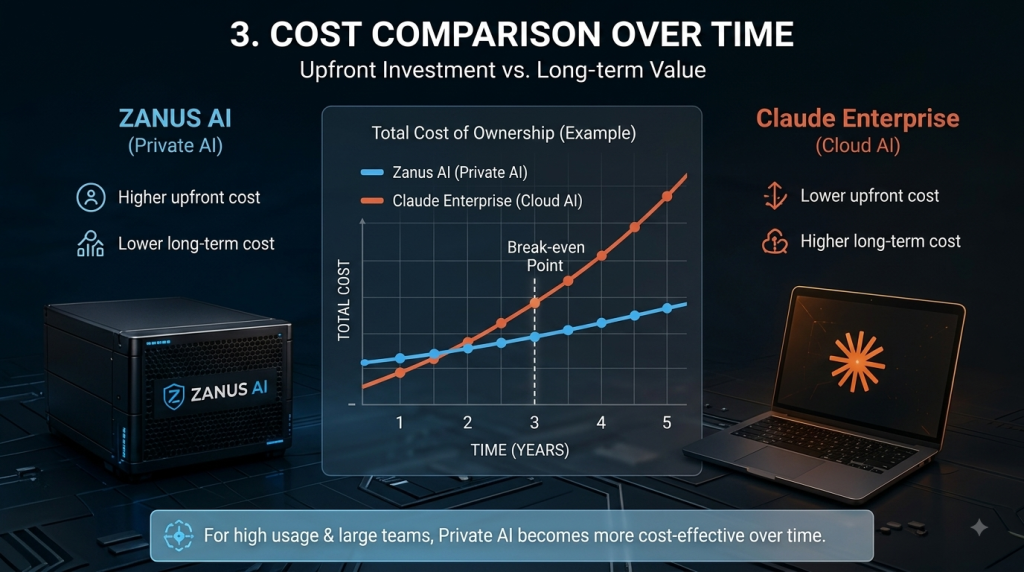
Quick Answer: Claude Enterprise runs a hybrid pricing model — a low fixed seat fee ($20/user/month) paired with usage costs that swing significantly based on model choice and volume, making total spend harder to predict than ChatGPT Enterprise. Zanus AI keeps its defining trait: cost stays largely fixed after the initial investment.
| Component | Zanus AI (Private AI) | Claude Enterprise (Cloud AI) |
|---|---|---|
| Cost structure | One-time CapEx purchase + annual maintenance | Seat fee ($20/user/month) + usage billed separately at API rates |
| Starting cost | ~$19,900–$150,000+ (estimated) | Seats: ~150 users × $20 × 12 months ≈ $36,000/year, before usage* |
| Estimated real-world cost | Relatively fixed after Year 1 | ~$60–$250+/user/month depending on usage — can reach the hundreds of thousands annually for heavy-use teams* |
| Seat limits | Not applicable (bound by infrastructure capacity) | No cap (unlike the Team plan, capped at 150 seats) |
| What drives cost volatility | Little to none after the initial investment | Model choice (Opus costs notably more than Sonnet/Haiku), usage frequency, context length |
| Who’s responsible for operations | The business’s internal IT | Anthropic |
Figures above are third-party estimates or public pricing information as of 2026, not a fixed cost commitment — Claude Enterprise’s usage-based billing means actual spend depends entirely on each organization’s usage patterns. Request a specific cost estimate from Anthropic based on your expected volume.
Our [Zanus AI Pricing: How Much Does Zanus AI Really Cost?] article breaks down the full 3–5 year TCO on the Zanus AI side.
Worth flagging specifically: because Claude Enterprise splits seat fees from usage fees, it’s the hardest pricing model to predict among the three platforms compared across this series (Zanus AI, ChatGPT Enterprise, Claude Enterprise) — an organization running heavy workloads on Opus, its most expensive model, can end up paying substantially more than a seat-count estimate would suggest.
4. Features and User Experience Compared
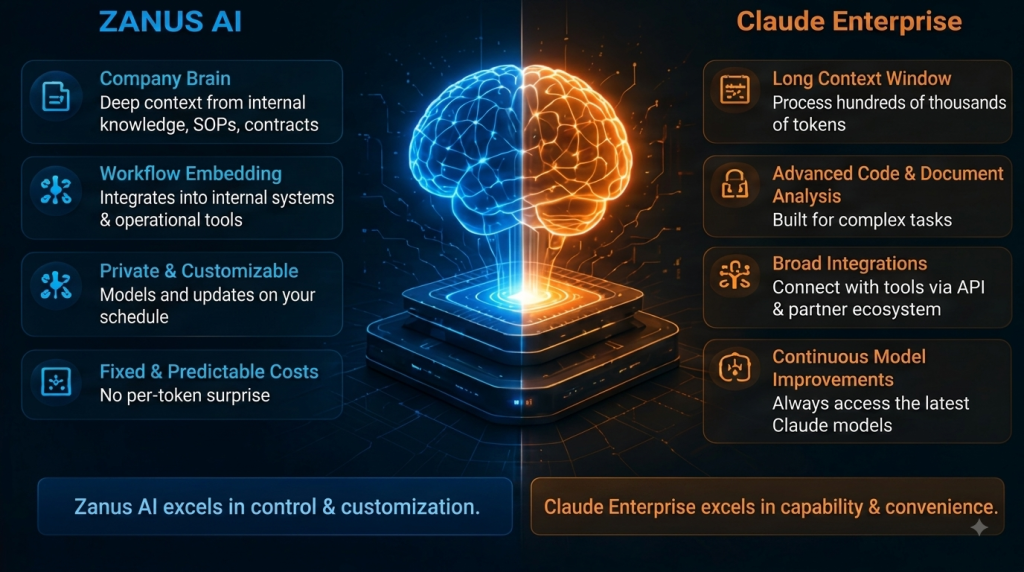
Quick Answer: Claude Enterprise stands out for long-context handling — well-suited to large document analysis — and deep code-focused tooling (Claude Code, native GitHub integration). Zanus AI keeps its edge in industry-specific customization and folding AI directly into internal operations through Company Brain.
Claude Enterprise capabilities (per Anthropic’s official product pages):
- An extended context window built for processing large volumes of material in a single session — useful for long contract review, multi-page financial reports, or large legal document sets.
- Claude Code is included directly with the Enterprise seat, with the ability to connect straight to a codebase so engineering teams can work across an entire repository.
- Connector governance: admins approve which connectors are available org-wide and set per-tool permissions, and connectors respect the access users already have in the underlying systems.
- No seat cap (unlike the Team plan’s 150-seat limit) — suited to very large organizations rolling AI out company-wide.
- Anthropic publicly states it does not train its models on enterprise customers’ conversation or content data.
Zanus AI capabilities:
- Still centers on Company Brain — internal knowledge built from the business’s own documents, SOPs, and contracts.
- Integrates directly into operational modules: document management, CRM, workflow automation.
- Model update pace follows Zanus AI’s own release schedule, not the near-instant cadence of a cloud service.
Bottom line: if your organization’s work revolves around long-document processing, complex contract analysis, or software development at scale, Claude Enterprise has a clear technical edge thanks to its context window and Claude Code. If the priority is AI that deeply understands specific internal processes and data that never leaves your own infrastructure, Zanus AI remains the better fit.
5. Summary: Which Solution Should You Choose?
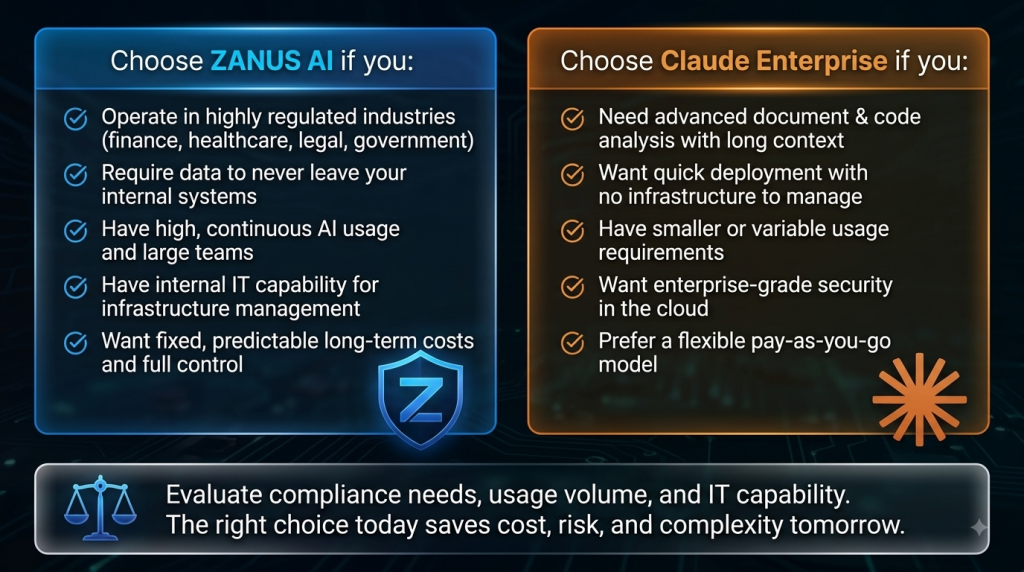
Choose Claude Enterprise if:
- Your core work involves long-document processing, complex text analysis, or large-scale software development.
- You need to scale AI across a very large organization without hitting a seat cap.
- You’re comfortable with a variable cost model (seat + usage) in exchange for flexibility and no infrastructure investment.
- Your security requirements can be met through contractual/technical commitments (customer-managed keys, US-only inference) rather than mandatory on-premises deployment.
Choose Zanus AI if:
- You’re in an industry with a hard legal requirement that data never leaves internal infrastructure.
- You want predictable long-term cost, independent of which model or how much volume gets used.
- You already have (or are ready to build) internal IT capable of running AI infrastructure.
- You want AI woven deeply into your organization’s institutional knowledge and internal operations.
📌 Related Reading: Weighing ChatGPT Enterprise as another option? Read our comparison: [Zanus AI vs ChatGPT Enterprise: Which One Should Your Business Choose?]
ThomasReview Verdict
Compared with ChatGPT Enterprise, Claude Enterprise brings a more sophisticated set of data controls to the table — customer-managed encryption keys, US-only inference — narrowing the gap with Private AI without requiring the business to run its own infrastructure. But it’s a narrowing, not a closing: the data still leaves the internal perimeter and lands on Anthropic’s infrastructure, no matter how many contractual layers sit on top of it.
For businesses where data never leaving the building is a hard requirement rather than a preference, Zanus AI remains the only option that satisfies that condition absolutely. For everyone else — particularly organizations whose workload centers on long documents and code — Claude Enterprise’s variable cost model is still a reasonable trade for the flexibility and processing power it delivers.
Sources
- Zanus AI official website — official hardware tiers, product specifications, and pricing structure
- Claude Enterprise Plan — Anthropic — official seat pricing, security features, data controls, and network controls
- What is Claude Enterprise Pricing in 2026? — GoSearch — real-world usage cost estimates beyond the base seat fee
- Claude now works with more security and compliance tools — Anthropic — Compliance API and enterprise security integration details
- Zanus AI vs ChatGPT Enterprise: Which One Should Your Business Choose? — ThomasReview’s comparison covering the cloud AI alternative
Disclaimer: Cost and feature details in this article are based on Anthropic’s public information and independent analysis at the time of writing (2026), and are subject to change. Organizations should verify pricing and technical specifications directly with Zanus AI and Anthropic before making an investment decision.
