
Quick Answer
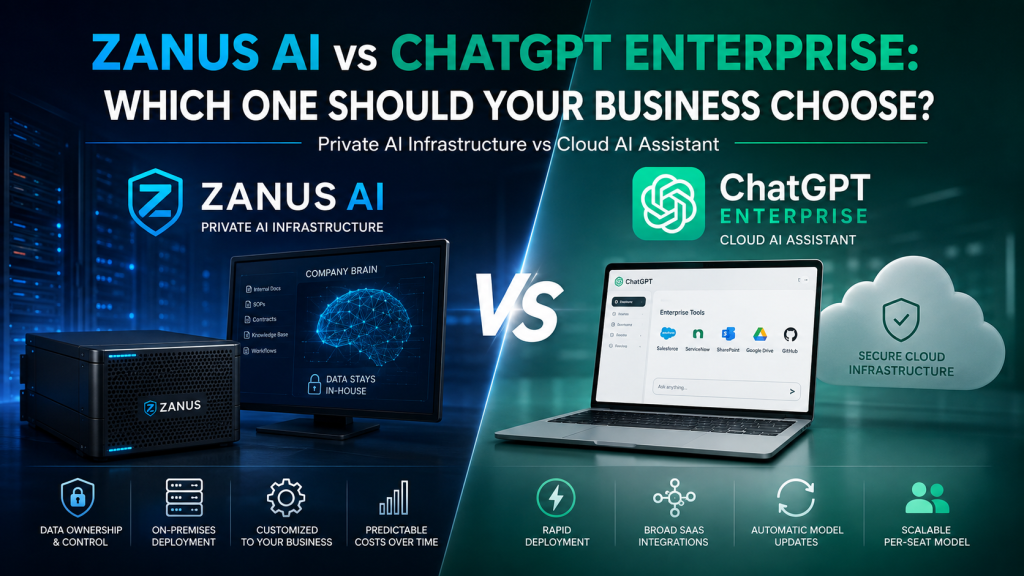
Zanus AI and ChatGPT Enterprise aren’t really competing head-to-head — they solve two fundamentally different problems. ChatGPT Enterprise is a cloud-based AI assistant that is quick to deploy, built for businesses that want AI support for everyday workflows without upfront infrastructure investment. Zanus AI is a Private AI infrastructure solution designed for organizations that prioritize absolute data control, data sovereignty, and have enough usage volume to make owning dedicated hardware cost-effective over the long run.
| Criteria | Zanus AI | ChatGPT Enterprise |
|---|---|---|
| Data Processing Location | Internal on-premises infrastructure | OpenAI’s cloud environment |
| Pricing Model | One-time CapEx purchase + annual SLA/maintenance | Per-seat monthly/annual subscription |
| Starting Cost | ~$19,900–$150,000+ (third-party estimates) | ~150-seat minimum (~$108,000/year and up) |
| Deployment Time | Approximately 3 weeks (vendor-claimed) | Nearly instantaneous |
| Infrastructure Management | Internal IT team / managed partner | Managed entirely by OpenAI |
| Best Fit For | Regulated sectors: finance, healthcare, legal, government | Businesses needing rapid AI deployment without on-prem requirements |
1. What’s the Core Difference Between Zanus AI and ChatGPT Enterprise?
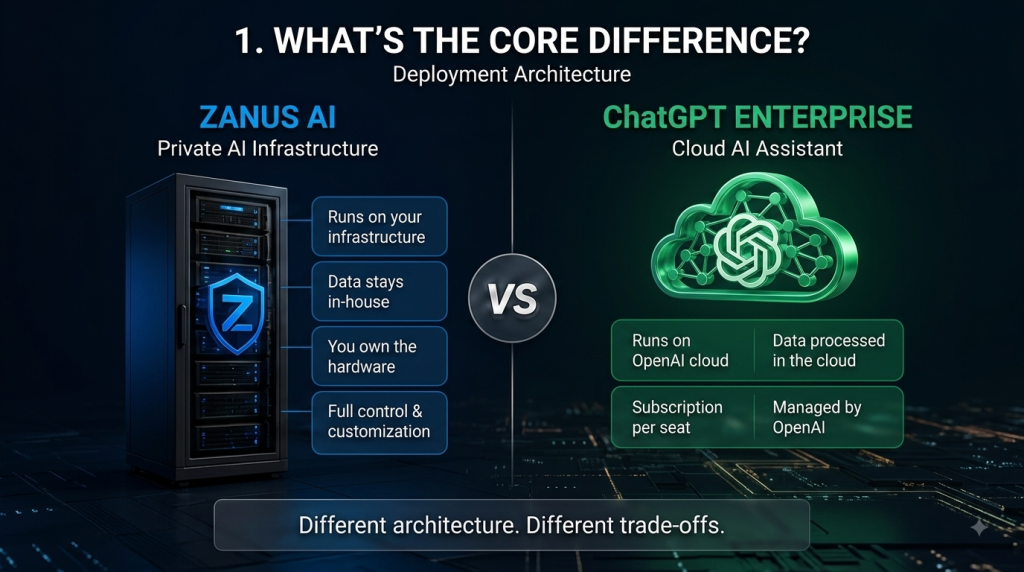
The real difference isn’t “which AI model is smarter” — it comes down to deployment architecture.
ChatGPT Enterprise is a Software-as-a-Service (SaaS) solution: you pay a subscription fee per seat, data is processed on OpenAI’s cloud infrastructure, and no physical hardware is required. Zanus AI is an infrastructure product: the business purchases an AI Server bundled with an AI Operating System outright and runs it securely within its own network perimeter.
This core architectural difference shapes every other operational dimension — where data resides, who oversees maintenance, how costs scale, and how quickly the solution can be implemented.
2. Security and Data Ownership Compared
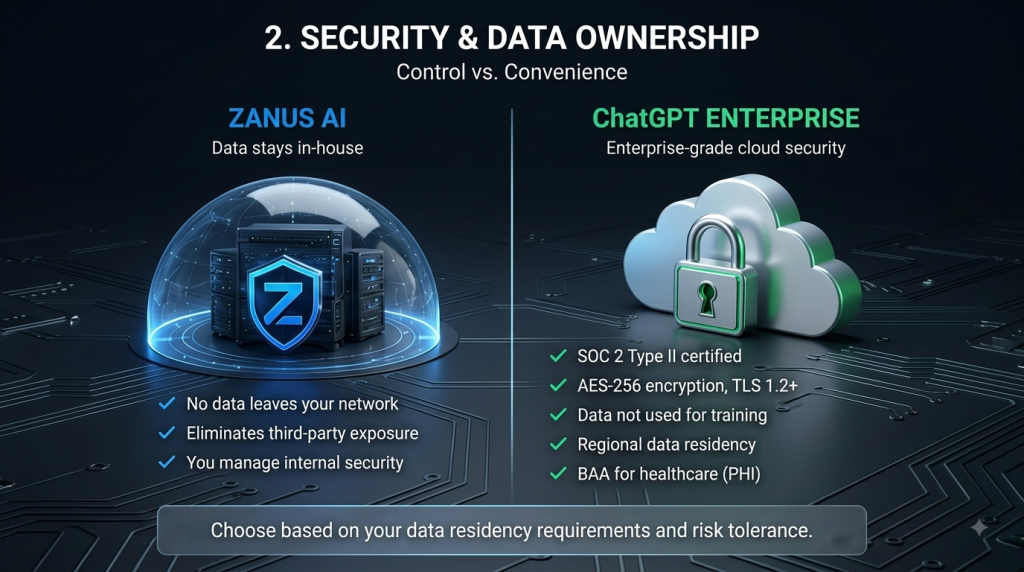
Quick Answer: ChatGPT Enterprise offers robust enterprise-grade security certifications (SOC 2 Type II, AES-256/TLS 1.2+ encryption, regional data residency), but data still leaves your network to land on OpenAI’s infrastructure. Zanus AI retains data entirely in-house, eliminating third-party data exposure at the architectural level — though the business remains responsible for securing its own internal environment.
ChatGPT Enterprise — key security aspects:
- Training exclusion: Customer data submitted through the Enterprise tier is excluded from training OpenAI’s base models by default.
- Compliance and key management: The platform holds SOC 2 Type II certification, supports Enterprise Key Management (EKM) for customer-controlled encryption keys, and offers Zero Data Retention (ZDR) by default.
- Data residency: OpenAI supports localized data residency across key regions, including the US, EU, UK, Japan, Canada, South Korea, Singapore, Australia, India, and the UAE.
- The human factor and shadow AI: Independent security evaluations consistently point to user behavior as the primary risk — employees pasting sensitive information (PII, proprietary source code, internal records) into AI tools outside IT’s visibility.
- Healthcare compliance: Organizations processing Protected Health Information (PHI) need a signed Business Associate Agreement (BAA) with OpenAI, available exclusively on the Enterprise tier.
- Zanus AI — key security aspects:
- Data stays in-house by design: Because data never leaves internal infrastructure, the risks tied to third-party data transmission are removed at the architecture level, not just policed after the fact.
- Internal governance required: The business must manage its own network perimeter, firewall policies, access controls, and hardware maintenance without a cloud provider’s security team behind it.
Bottom line: If your primary concern is keeping data from ever leaving your internal network, Private AI platforms like Zanus AI solve that at the infrastructure level. If the bigger risk is how employees actually use AI day to day, neither platform solves that on its own — both still call for clear internal usage policy and access controls.
3. Cost Comparison: Zanus AI vs. ChatGPT Enterprise
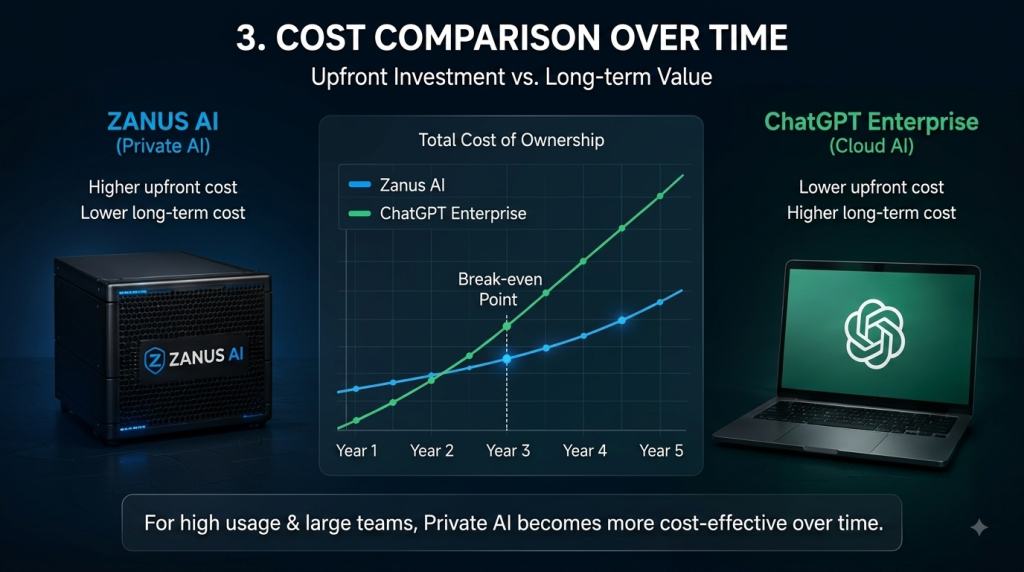
Quick Answer: ChatGPT Enterprise requires lower initial capital but scales linearly with headcount every year. Zanus AI carries a higher Year 1 investment (CapEx) but holds predictable, largely fixed operating costs in the years after. The break-even point typically lands around Year 2 or Year 3 for organizations with steady, high-volume usage.
| Component | Zanus AI (Private AI) | ChatGPT Enterprise (Cloud AI) |
|---|---|---|
| Cost structure | One-time CapEx purchase + annual maintenance | Per-seat subscription, billed annually |
| Estimated entry price | Prime: ~$19,900–$54,900*; Enterprise Cluster: ~$120,000–$150,000+* | ~$45–$75/user/month* (~150-seat minimum) |
| Year 1 cost (150 users) | Higher upfront CapEx | ~$108,000+ per year |
| Years 2–3 outlook | Largely fixed — maintenance plus power/cooling only | Recurring subscription cost that scales with seat count |
| Hidden/additional costs | Internal IT management, electricity and cooling | “Shadow AI” spend and unmanaged/underused seats |
| Best fit for | High-volume usage, strict compliance needs | Fast rollout, flexible workforce scaling |
Figures are based on third-party industry estimates and market reports as of 2026. Neither vendor publishes a static public price list. Request a direct quote from each vendor for precise figures.
For a full breakdown of 3–5 year Total Cost of Ownership (TCO), see our guide: [Zanus AI Pricing: How Much Does Zanus AI Really Cost?]
Rule of thumb: For organizations with fewer than 50–100 regular users, or fluctuating workloads, ChatGPT Enterprise is generally more cost-effective over a 3-year timeline. For larger organizations with high, continuous AI usage, the cumulative cost curve tends to shift in favor of Private AI.
4. Features and User Experience Compared
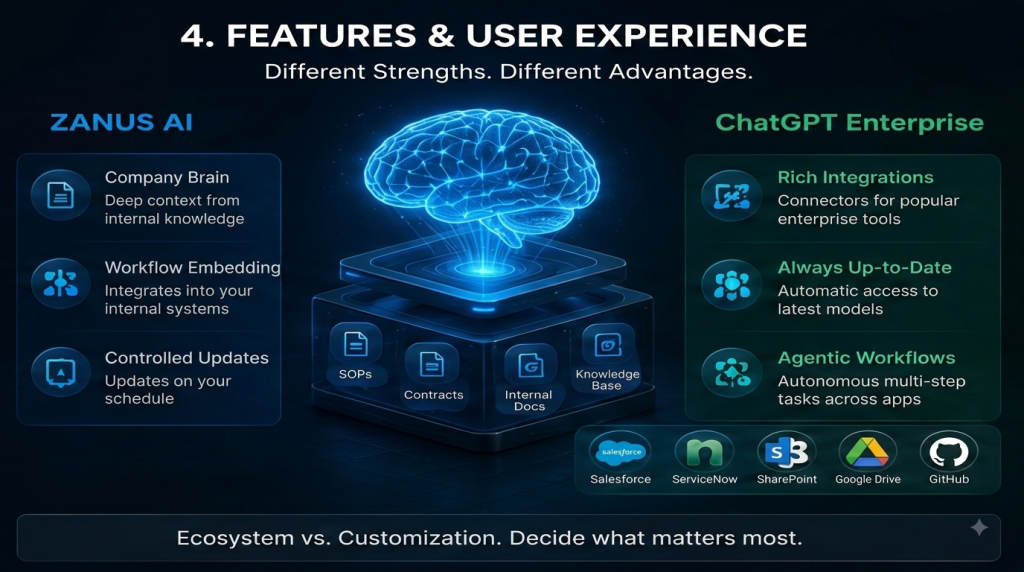
Quick Answer: ChatGPT Enterprise excels at its integration ecosystem, agentic capabilities, and automatic model upgrades. Zanus AI stands out for deep context customization through Company Brain and tight integration into internal enterprise workflows.
ChatGPT Enterprise capabilities:
- Turnkey integrations: Out-of-the-box connectors for enterprise tools including Salesforce, ServiceNow, SharePoint, Google Drive, and GitHub.
- Automated model updates: Continuous access to OpenAI’s latest model releases with no manual infrastructure maintenance required.
- Agentic workflows: Supports autonomous, multi-step tasks across integrated business applications.
Zanus AI capabilities:
- Company Brain context: An internal knowledge layer built from local SOPs, proprietary contracts, and internal documents.
- Workflow embedding: Runs directly inside internal operational modules — document repositories, CRM systems, automated pipelines — rather than acting as a standalone chat widget.
- Controlled update cycles: System and model updates follow scheduled internal maintenance windows, avoiding the unexpected behavior changes that come with continuous cloud updates.
Bottom line: If your business needs an AI assistant that plugs quickly into a wide range of existing SaaS tools, ChatGPT Enterprise has the richer ecosystem. If your business needs AI that understands specific internal processes deeply and doesn’t want its behavior shifting on an outside vendor’s release schedule, Zanus AI is the better fit.
5. Summary: Which Solution Should You Choose?
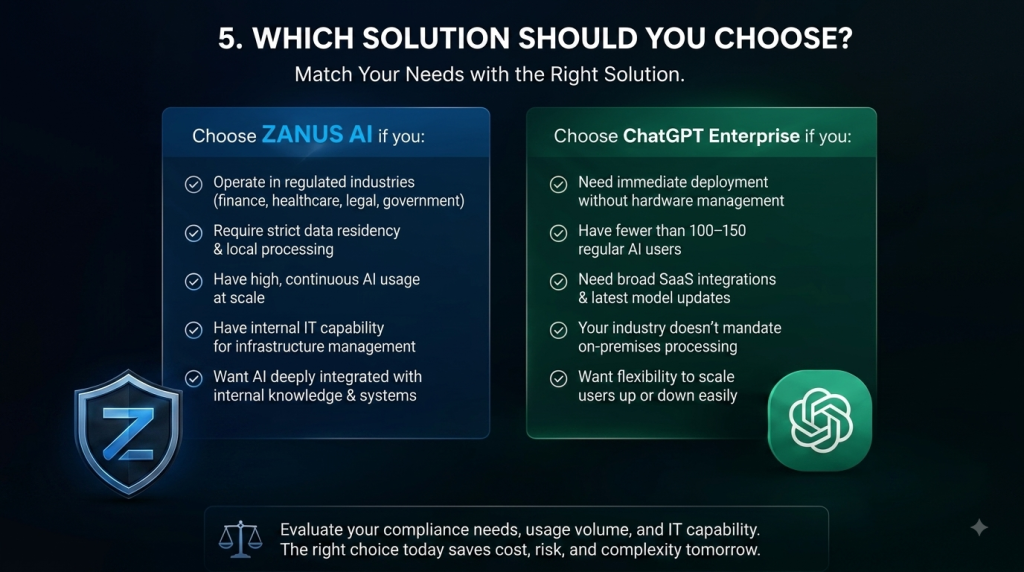
Choose ChatGPT Enterprise if:
- You require immediate deployment without managing physical server hardware.
- Your organization has fewer than 100–150 regular AI users, or usage patterns are still variable.
- You need broad SaaS integrations and immediate access to frontier model updates.
- Your industry doesn’t mandate strict on-premises data processing.
Choose Zanus AI if:
- You operate in a heavily regulated industry (finance, healthcare, legal, government) that requires strict data residency and local processing.
- Your team size and AI query volume make a predictable hardware investment more economical than a recurring seat subscription.
- You have existing internal IT capability for infrastructure management — or plan to build one.
- You want AI deeply integrated with institutional knowledge and internal operational systems, not just a general-purpose chat assistant.
📌 Related Reading: If your organization is evaluating cloud AI options but needs specialized long-context document analysis and complex code execution, read our detailed comparison: [Zanus AI vs Claude Enterprise: Which Solution Is the Better Fit?]
ThomasReview Verdict
Comparing Zanus AI and ChatGPT Enterprise isn’t about crowning a universal winner — the two serve distinct enterprise deployment philosophies. ChatGPT Enterprise maximizes speed, flexibility, and ease of use; Zanus AI prioritizes absolute data ownership and a cost curve that flattens out over time instead of climbing with it.
Before making an investment decision, weigh three core factors:
- Regulatory requirements around where your data is allowed to reside.
- Expected long-term usage volume and user concurrency.
- Your organization’s in-house IT capability for infrastructure management.
Get those three right, and the rest of the decision — server versus subscription, CapEx versus per-seat billing — tends to fall into place on its own.
Sources
- Zanus AI official website — official hardware tiers, product specifications, and pricing structure
- ChatGPT Enterprise Pricing Guide (2026) — Beam Cloud — market-reported per-seat pricing, seat minimums, and annual floor cost
- ChatGPT Security Risks in Enterprise: 2026 Guide — Strac — SOC 2 Type II, Zero Data Retention, encryption, and shadow AI risk data
- Is ChatGPT Safe for Business in 2026? — Metomic — data training exclusion policy and enterprise-tier security posture
- Zanus AI Pricing: How Much Does Zanus AI Really Cost? — ThomasReview’s full 3–5 year TCO breakdown on the Zanus AI side
Disclaimer: Cost and feature details in this evaluation are based on publicly available data, industry benchmarks, and third-party assessments as of 2026, and are subject to change. Organizations should verify pricing and technical specifications directly with Zanus AI and OpenAI before finalizing procurement decisions.
